

Art creates conversation by functioning as a medium of human exchange, not merely a product of solitary expression. Every painting, sculpture, or performance carries embedded questions that demand a response from the viewer. This is why art creates conversation across cultures, generations, and ideological divides in ways that direct speech often cannot. From UNESCO’s global Art-Lab initiatives to conceptual artist David Deighton’s civic dialogue projects, the evidence is consistent: art does not wait to be interpreted in silence. It pulls people into dialogue, and that dialogue is where meaning actually lives.
Why art creates conversation: the historical foundation
Art has always required an audience, and audiences have always talked back. The salon culture of 18th-century Paris established a template still recognizable today: a work of art placed at the center of a room, surrounded by people whose disagreements and enthusiasms shaped what that art ultimately meant. The Parisian avant-garde, the Harlem Renaissance, and the jazz improvisation circles of mid-century America all confirm the same pattern. Major artistic movements did not emerge from isolated genius. They grew from dialogue and collaborative friction between artists, critics, patrons, and ordinary people who had opinions.
Virginia Woolf’s Bloomsbury Group is a precise example. The group produced literature, visual art, and economic theory simultaneously, because the conversations between members were inseparable from the creative output. Art was the catalyst, but conversation was the engine. This is the theoretical core of why art sparks debate: it introduces a shared object that people can agree or disagree about without the conversation becoming purely personal.
The digital era briefly threatened this dynamic by replacing intimate exchange with broadcast. Social media turned art into content optimized for passive consumption. The response has been a measurable return to controlled, smaller conversation formats. Platforms designed for intentional dialogue, curated gallery talks, and community exhibitions have grown precisely because people recognize what mass broadcasting cannot deliver.
“Art requires the friction of meeting minds, where conversation is as essential as the artwork itself for meaning-making and cultural advancement.” — Art-Sheep
Pro Tip: If you want to use art as a conversation starter in a group setting, choose a piece with deliberate ambiguity. Works that resist a single interpretation generate more sustained dialogue than those with obvious messages.
What psychological mechanisms make art so effective at sparking dialogue?
Art bypasses the intellectual filters that make direct political or personal conversation feel threatening. When you stand in front of Picasso’s Guernica, you do not process it as an argument to be rebutted. You process it as an experience to be felt. This distinction matters enormously for dialogue. Art functions as soft power, fostering reconciliation and emotional understanding across ideological divides where rational arguments consistently fail.
Several specific mechanisms explain this effect:
- Narrative imagining. Narrative art forms engage viewers in the experiences and worldviews of others, enabling the moral reflection needed for genuine empathy. When a story or image places you inside another person’s reality, you are more likely to ask questions than to defend positions.
- Aesthetic resonance. The shared experience of finding something beautiful, disturbing, or moving creates common ground between strangers. That common ground is the starting point for conversation.
- Symbolic communication. Art speaks through symbols, metaphors, and sensory cues that carry meaning without requiring agreement on definitions. Two people can respond to the same image for entirely different reasons and still find themselves in productive dialogue.
- Vulnerability as invitation. Cross-cultural dialogue through art demands vulnerability and authentic storytelling. When an artist exposes something genuine, viewers feel permission to respond honestly rather than defensively.
The impact of art on dialogue is also measurable in peacebuilding contexts. Antonin Artaud’s Theatre of Cruelty and public performances depicting trauma act as moral calls inviting audience engagement, creating catharsis that opens rather than closes conversation. The ‘power of taste’ in aesthetics acts as a form of ethical resistance, helping societies reject propaganda and cultivate genuine peace through shared artistic judgment.
Pro Tip: When facilitating art-based dialogue in community settings, open with sensory questions rather than interpretive ones. Ask “What do you notice first?” before “What does this mean?” The sensory entry point lowers defensiveness and gets more people talking.
How different art forms serve as conversation starters
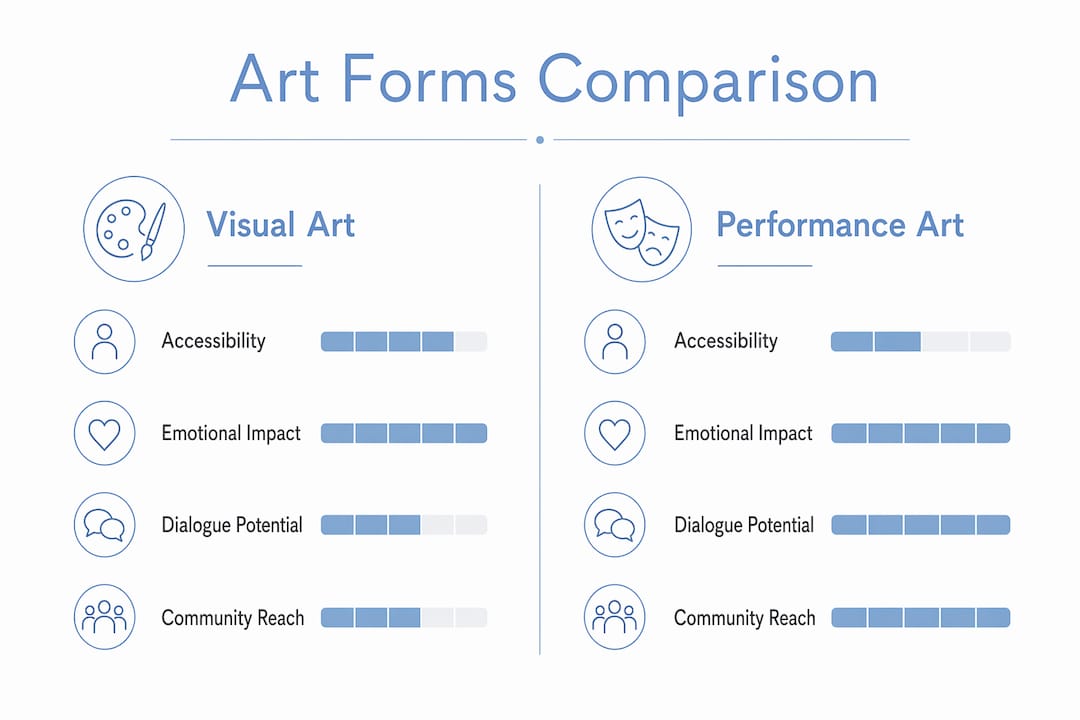
Not all art creates conversation in the same way. The medium shapes the dialogue. Visual art invites individual interpretation before collective exchange. Music, particularly improvised forms like jazz, makes the conversation visible in real time as musicians respond to each other. Performance art collapses the distance between creator and audience, making the viewer a participant rather than an observer.
The table below compares major art forms on four dimensions that determine their conversational power.
| Art form | Accessibility | Emotional impact | Dialogue potential | Community reach |
|---|---|---|---|---|
| Visual art (painting, print) | High | High | High, especially in shared spaces | Broad, scales from home to gallery |
| Music | Very high | Very high | Moderate (often passive listening) | Very broad, crosses language barriers |
| Performance and theater | Moderate | Very high | Very high, immediate audience response | Concentrated, requires presence |
| Poetry | Moderate | High | High, especially in spoken form | Moderate, strongest in literary communities |
| Conceptual and civic art | Low to moderate | Moderate to high | Very high, designed for dialogue | Targeted, often community-specific |
UNESCO’s Art-Lab, which expanded to 15 global projects by 2025, deliberately uses visual arts, performance, and community interventions together because no single form reaches every audience. The combination creates multiple entry points for dialogue, which is the key design principle behind any serious art-and-community program.
Contemporary exhibitions focused on identity, memory, and resilience demonstrate how art and community discussions reinforce each other. When a neighborhood sees its own history reflected in a public mural or a gallery show, the art does not just represent the community. It gives the community a reason to gather and speak.
Practical ways to use art to spark meaningful conversations
The role of art in communication becomes most concrete when you look at specific methods that have produced documented results. Conceptual artist David Deighton developed an approach he calls art as civic science, using non-confrontational, open-ended questions about sensory experiences to initiate dialogue between strangers across political divides. Facilitators trained in his method can conduct up to 50 brief conversations in a single day. That number matters because it demonstrates scale: art-based dialogue is not limited to intimate gallery settings.
Here is a practical framework for using art to generate conversation in community or personal contexts:
- Select art with interpretive openness. Abstract and conceptual works generate more dialogue than illustrative or didactic pieces because they require the viewer to complete the meaning. Abstract landscape works placed in shared spaces consistently prompt questions and exchanges that representational art does not.
- Create a physical context for conversation. Art placed in a hallway gets glanced at. Art placed in a seating area with adequate lighting and proximity to other people gets discussed. The spatial arrangement signals whether conversation is expected.
- Use guided questions to open dialogue. Start with observation (“What colors or shapes stand out to you?”), move to association (“What does this remind you of?”), and only then invite interpretation (“What do you think the artist was responding to?”). This sequence mirrors Deighton’s civic science method and consistently produces deeper exchanges.
- Invite artists into the conversation. When the creator is present or accessible through recorded commentary, the dialogue gains a new dimension. Cross-cultural artistic exchange is most effective when it includes authentic storytelling from the artist, not just the finished work.
- Document and share the conversations. Communities that record responses to art, whether through written comment cards, social media, or structured feedback, create a secondary layer of dialogue that extends the conversation beyond the physical space and time of the exhibition.
Pro Tip: For home or office settings, rotate art periodically rather than leaving the same pieces in place indefinitely. Familiar art stops generating conversation. New or repositioned work reactivates attention and prompts fresh exchanges.
Key takeaways
Art creates conversation because it functions as a shared object of interpretation, bypassing intellectual defenses and activating empathy, narrative imagining, and aesthetic resonance simultaneously.
| Point | Details |
|---|---|
| Art is a medium, not a byproduct | Conversation is built into art’s function, not an accidental side effect of displaying it. |
| Psychological mechanisms drive dialogue | Narrative imagining, aesthetic resonance, and symbolic communication each lower barriers to honest exchange. |
| Art form shapes conversation type | Visual art, performance, and conceptual civic art each generate dialogue differently and serve different community needs. |
| Practical methods exist and scale | David Deighton’s civic science approach proves art-based dialogue can reach 50 strangers in a single day. |
| Context determines conversational impact | Spatial arrangement, guided questions, and artist presence all determine whether art generates dialogue or silence. |
Art as a living conversation, not a finished statement
I have spent years watching people interact with art in spaces ranging from formal galleries to living rooms, and the pattern is always the same. The pieces that generate the most conversation are rarely the most technically accomplished. They are the ones that leave something unresolved. The viewer has to bring something to complete them, and that act of completion is where the talking begins.
What I find genuinely underappreciated is how much the placement of art determines its conversational life. A print that hangs in isolation above a sofa becomes wallpaper within a week. The same print positioned near a chair, at eye level, in a room where people actually sit and talk, becomes a recurring reference point in conversations that have nothing to do with art. It becomes part of the room’s vocabulary.
The shift I have observed in recent years, back toward smaller, more intentional art experiences, feels significant. People are not rejecting art. They are rejecting the passive, scroll-past relationship with it that digital platforms normalized. They want to stand in front of something real, feel something, and then turn to the person next to them. That impulse is ancient. It is also exactly what good curated art is designed to activate.
The artists I respect most understand that they are not making finished statements. They are starting conversations and then stepping back to let those conversations go where they need to go. That is a form of generosity that the best art always embodies.
— DAVID
Bring art into your space and start the conversation
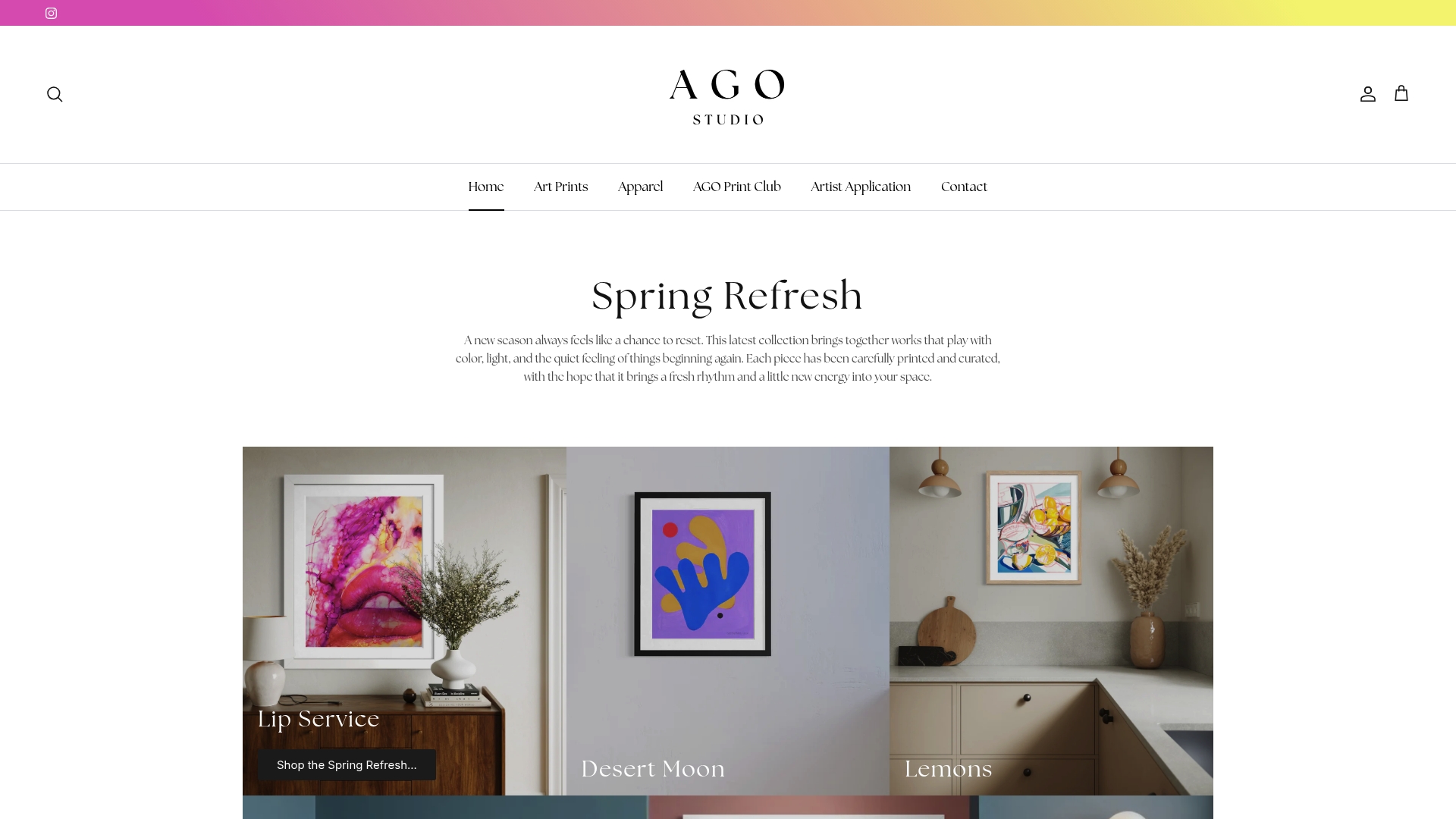
Agostudio curates original artworks selected specifically for their ability to generate feeling, memory, and dialogue. Every piece in the collection is chosen because it carries something unresolved, something that invites the viewer to respond rather than simply observe. If you are looking to transform a room from a space people pass through into one where they actually stop and talk, the art prints collection is the right starting point. For those who want ongoing access to new works and a community of people who take art seriously, the Artist Print Club connects members with artists and fellow collectors in a format designed for genuine exchange, not passive browsing.
FAQ
Why does art create conversation more effectively than direct discussion?
Art introduces a shared object that people can respond to without the exchange becoming personally confrontational. It activates emotional and symbolic processing rather than defensive argumentation, which makes honest dialogue more likely.
What art forms are best for starting community discussions?
Conceptual and civic art forms are specifically designed for dialogue, but visual art placed in shared community spaces consistently generates the broadest and most sustained conversation across different audiences.
How does UNESCO use art to facilitate dialogue in conflict zones?
UNESCO’s Art-Lab program supports community-based projects using visual arts, performance, and community interventions in conflict-affected regions. The program expanded to 15 global projects by 2025, giving voice to communities that rational or political discourse has failed to reach.
Can art really bridge political and ideological divides?
David Deighton’s civic science method demonstrates that art-based dialogue using sensory, non-confrontational questions measurably decreases outrage and builds empathy between strangers who hold opposing views, with facilitators reaching up to 50 people in a single day.
How do I choose art that will spark conversation in my home or office?
Choose works with interpretive openness rather than obvious messages. Abstract and conceptual pieces require viewers to complete the meaning themselves, and that act of interpretation is what generates conversation. Placement matters as much as the work itself.