

Expressing personality through art means developing a consistent creative style that authentically reflects your inner world, values, and emotional experience. Your choices in color, subject matter, line quality, and medium are not arbitrary. They are a visual identity, as recognizable and personal as a signature. This guide combines 2026 psychological research with practical expressive art practices to help you build that identity with confidence, whether you are just starting out or looking to deepen what you already make.
How to express personality through art: what your choices reveal
Every mark you make in art carries information about who you are. Art style acts as a visual identity, reflecting authentic choices in color, line, form, and subject matter that accumulate into something unmistakably yours. Most people underestimate how much their instinctive preferences already reveal.
Cornell psychology research confirms that artistic pursuits offer greater access to one’s true self than moral pursuits, because art operates with fewer rules and more personal autonomy. That freedom is exactly what makes art such a precise mirror. When no one is telling you what to paint, what you choose to paint tells the whole story.

The personality traits that most strongly predict expressive range in art are openness to experience and self-compassion. Research shows that self-kindness buffers negative self-judgment, encouraging persistence and risk-taking in creative work. This means the artist who is gentle with their own mistakes tends to develop a more distinct voice than the one who edits themselves into silence.
Look at your own body of work, even if it is small. Notice what subjects you return to without being asked. Notice which colors you reach for first. Those patterns are not accidents. They are your personality speaking in the only language it knows when technique steps aside.
- Color choices signal emotional temperature. Warm palettes often reflect extroversion or nostalgia; cool, muted tones frequently appear in work by people who process inward.
- Subject matter reveals preoccupation. Artists drawn to domestic interiors, like Vilhelm Hammershøi, or to raw natural landscapes, like Emily Carr, were each expressing a worldview, not just a preference.
- Line quality reflects nervous system and temperament. Loose, gestural marks suggest spontaneity; tight, controlled linework suggests a need for order or precision.
- Recurring themes are the clearest signal. If you keep painting solitude, or connection, or decay, that repetition is meaning.
How do you develop your own artistic style?
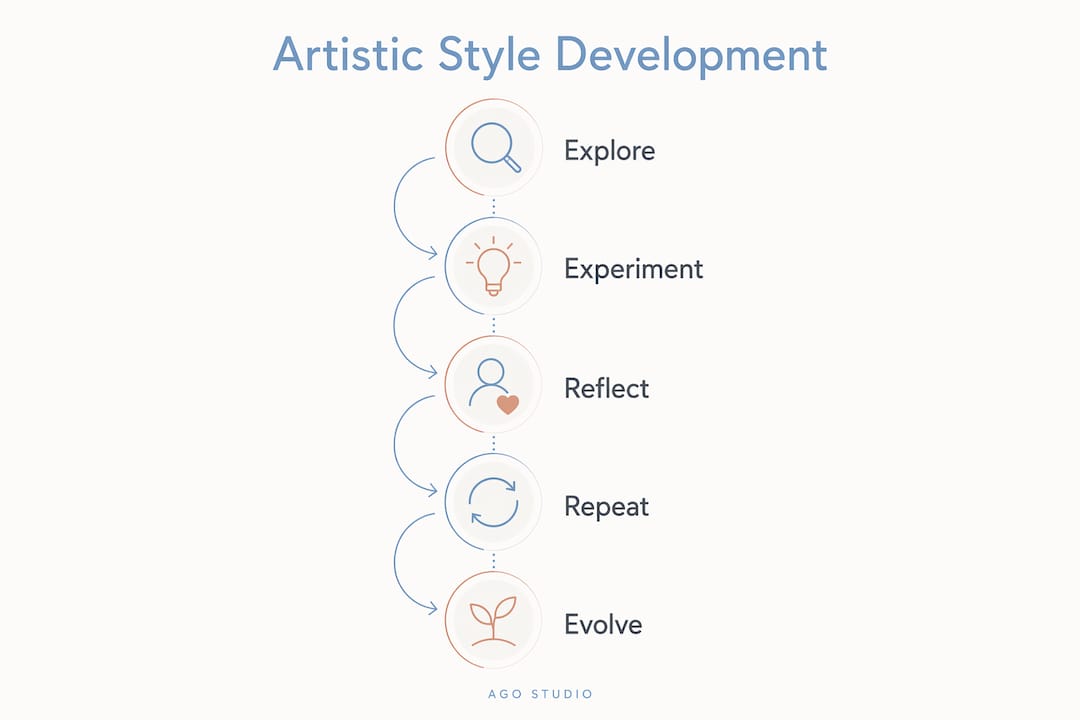
Personal style is not invented. It is uncovered through repetition and honest reflection. Personal style emerges from repeated micro-decisions; designing constraints helps reveal authentic choices naturally. The fastest way to find your voice is to make a lot of work under the same conditions and then look at what stays consistent.
Here is a structured process that works:
- Choose one subject and repeat it 15 times. Paint or draw the same object, person, or scene in 15 different ways. Vary the medium, the scale, the mood. After 15 versions, patterns in what you favor will be impossible to ignore.
- Complete 20 pieces in a single month. Volume forces you past self-consciousness. The first five pieces are careful. By piece fifteen, you are making instinctive choices. Those instinctive choices are your style.
- Keep a brief reflection note after each session. Write two or three sentences about what felt right and what felt forced. Over weeks, these notes become a map of your aesthetic preferences.
- Limit your palette deliberately. Restricting yourself to three or four colors removes one layer of decision fatigue and forces you to solve problems in ways that reveal your natural tendencies.
- Study artists you love, then make work without looking at them. Influence absorbed and then set aside becomes part of your own voice rather than imitation.
Pro Tip: Set a timer for 10 minutes and make a piece with no reference material and no plan. Do this once a week for a month. The results will show you what your hand does when your critical mind is not in charge.
The table below maps common artistic tendencies to the style elements they typically produce, giving you a practical reference for recognizing your own patterns.
| Tendency | Style element it shapes |
|---|---|
| Drawn to emotional intensity | High contrast, saturated color, expressive mark-making |
| Preference for calm and order | Muted palettes, geometric composition, clean edges |
| Fascination with memory or nostalgia | Soft focus, warm tones, domestic or childhood subjects |
| Interest in the natural world | Organic forms, earthy colors, loose observational line |
| Attraction to abstraction | Non-representational form, texture-heavy surfaces, layered media |
What are expressive arts principles and why do they matter?
Expressive arts is a recognized practice that prioritizes process over product. Expressive arts focus on a low-skill, high-sensitivity approach, emphasizing sensory experience over technical skill. This matters because most people abandon artistic self-expression not from lack of talent but from fear of judgment, including their own.
The core principles of expressive arts work directly against that fear:
- Sensory engagement before interpretation. You interact with materials physically first. The feel of charcoal on paper, the resistance of clay, the smell of oil paint. This sensory entry point bypasses the critical mind and lets identity material surface naturally.
- Decentering from critique. Expressive arts deliberately delays the question “what does this mean?” Meaning-making comes after making, not during. This removes the paralysis that kills creative momentum.
- Non-judgment as a practice. The goal is not a good painting. The goal is an honest one. These are not the same thing, and confusing them is the single biggest obstacle to authentic expression.
- Imagination as a tool. Guided imagery, metaphor, and imaginative prompts help you access material that direct self-reflection often misses.
“The creative process itself, rather than the finished product, is where personality most honestly emerges.” This principle, drawn from person-centered therapy and expressive arts, reframes what success in art actually looks like.
Early avoidance of interpretation in expressive arts fosters a safe creative space that aids emotional acceptance and prevents performance anxiety. The practical implication: make the work first, analyze it later, and be slow to decide what it means.
What tools and mediums best support authentic self-expression?
The medium you choose shapes what you can say. Watercolor rewards surrender and spontaneity. Oil paint rewards patience and revision. Collage rewards association and juxtaposition. None of these is better than the others. The right medium is the one that matches how you think and feel.
| Medium | Best for | Personality fit |
|---|---|---|
| Watercolor | Fluid, intuitive expression | Spontaneous, emotionally responsive creators |
| Graphite or ink | Precision, observation, detail | Analytical, introspective, or process-oriented artists |
| Acrylic paint | Versatility, layering, experimentation | Adaptable creators who enjoy iteration |
| Collage | Association, narrative, mixed media | Conceptual thinkers drawn to meaning-making |
| Pastel or charcoal | Gestural, tactile, immediate | Artists who work from feeling rather than planning |
Arts engagement activates about 50 mechanisms that impact emotion regulation, social brain engagement, and resilience. This is not a minor side effect of making art. It is the mechanism by which art becomes a tool for self-discovery rather than just decoration.
Pro Tip: Try working in a medium that intimidates you for 30 days before deciding it is not for you. Discomfort in a new medium often signals that it is asking you to express something you have not yet put into words.
Incorporating multiple modalities deepens the process. Combine drawing with movement, or make work while listening to music that matches the mood you want to capture. Expressive arts practices start with sensory and kinesthetic engagement before adding symbolic or cognitive reflection, allowing identity material to emerge gradually. This sequencing is not accidental. It mirrors how personality actually surfaces: through the body before the mind.
Recognizing your personal motifs takes time. Keep a folder, physical or digital, of work you feel proud of without knowing why. Review it every few months. The recurring elements in that folder are your artistic fingerprint. You can find curated examples of distinct personal styles through original art resources that show how different artists have built recognizable voices across varied mediums.
Key takeaways
Authentic artistic self-expression develops through consistent, process-focused practice that prioritizes honest instinct over technical perfection or external approval.
| Point | Details |
|---|---|
| Style is revealed, not invented | Repeat one subject many times and your authentic preferences will surface naturally. |
| Personality shows in micro-decisions | Color, line quality, and subject matter each carry specific personality signals worth tracking. |
| Process matters more than product | Expressive arts principles show that making without judgment produces more honest work than aiming for a polished result. |
| Medium choice shapes expression | Match your medium to how you think and feel, not to what looks impressive or difficult. |
| Self-compassion fuels creative growth | Artists who practice self-kindness take more creative risks and develop stronger personal voices over time. |
Why I think most advice on finding your artistic voice misses the point
Most guides on artistic self-expression focus on technique: learn color theory, study composition, copy the masters. That advice is not wrong, but it addresses the wrong problem. The people who struggle to express personality through art are not struggling because they lack skill. They are struggling because they are editing themselves before they even start.
I have seen this pattern repeatedly. Someone sits down to paint and immediately begins comparing the work to something they admire, or imagining how it will be received. The result is cautious, derivative, and lifeless. Not because the person lacks a personality worth expressing, but because they never gave it permission to show up.
The research on artistic pursuits and the true self confirms what I have observed in practice: art gives you access to parts of yourself that social performance and moral expectation keep hidden. That access only opens when you stop performing for an imagined audience.
The most distinctive artists I have encountered share one habit. They make work that embarrasses them a little. Not because they are reckless, but because they are honest. The work that feels too personal, too strange, or too simple is almost always the work that resonates most with other people. Imperfection is not a flaw in your artistic voice. It is often the clearest part of it.
Give yourself permission to make bad work on purpose. Make work that no one will see. Make work that breaks the rules you think you are supposed to follow. Your personality will not emerge from careful compliance. It will emerge from the moment you stop trying to hide it.
— DAVID
Discover art that speaks your language
If you are building your visual voice, surrounding yourself with art that already has one is one of the most effective things you can do. Agostudio curates original works selected specifically for their emotional authenticity and the strength of the artist’s personal expression.
Browse the art prints collection to see how real artists have translated distinct personalities into visual form. Each piece in the Agostudio catalog is chosen because it carries a point of view, not just an aesthetic. For ongoing inspiration, the Artist Print Club delivers curated prints regularly, giving you a rotating reference point for what a fully realized artistic voice actually looks like in practice.
FAQ
Why does art reflect personality so accurately?
Art reflects personality because it operates with fewer social rules than most human activities. Cornell research shows that artistic pursuits offer greater access to the true self than moral pursuits, precisely because the absence of fixed rules allows authentic preferences to surface.
How long does it take to develop a personal artistic style?
Most practitioners see recognizable patterns emerge after completing 20 to 30 pieces with intentional reflection. Structured exercises like repeating a subject daily and keeping reflection notes can accelerate this process to weeks rather than years.
Do I need technical skill to express my personality through art?
No. Expressive art practices are built on a low-skill, high-sensitivity approach that prioritizes sensory engagement and emotional honesty over technical ability. Personality emerges most clearly when the focus is on process rather than producing a polished result.
What role does self-compassion play in artistic self-expression?
Self-compassion directly supports creative risk-taking. Research confirms that self-kindness buffers negative self-judgment, which encourages artists to persist through uncertainty and make bolder, more authentic choices.
Which art medium is best for expressing personality?
The best medium is the one that matches how you naturally think and feel. Watercolor suits spontaneous, emotionally responsive creators; graphite and ink suit analytical or introspective ones. Trying an unfamiliar medium for 30 days before judging it is a reliable way to discover unexpected alignment between a material and your personality.