

Original art is defined as a unique, hand-created work made entirely by the artist, while print art is a reproduction of that work made through mechanical or digital processes. For first-time buyers, understanding original vs print art is the single most important step before spending money on a piece for your home. The differences go far beyond price. They affect texture, longevity, emotional weight, and long-term value. This guide gives you the practical tools to tell them apart, understand how each is made, and decide which belongs on your wall.
How can you identify original art versus print art?
Surface texture is the most reliable visual indicator for distinguishing originals from prints. An original painting carries raised, uneven paint layers built up by the artist’s hand. A print sits completely flat, with no variation in surface height regardless of how detailed the image looks.
Here are five practical ways to tell them apart:
-
Hold it under raking light. Tilt the piece at a sharp angle to a light source. Originals reveal depth through shadows cast by brushstrokes and impasto. Prints reflect light evenly with no shadow variation at all.
-
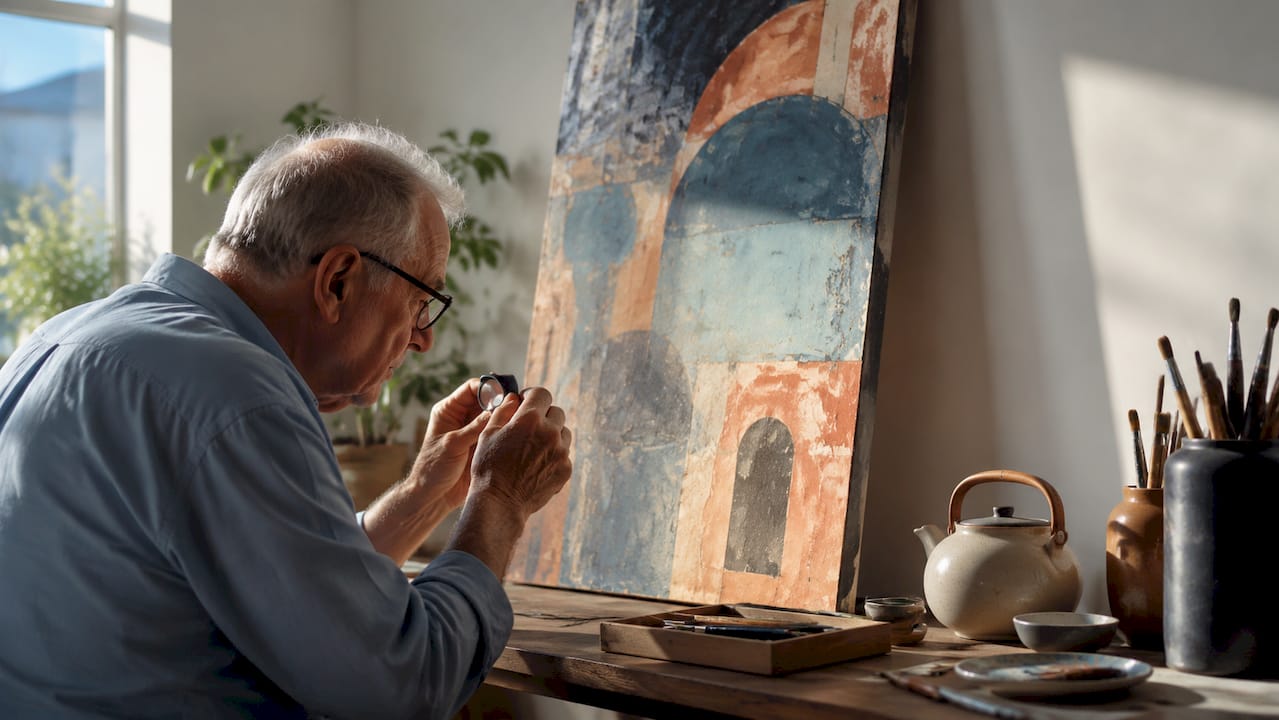
Use a magnifying glass. Look closely at any area of the image. Mechanical and digital prints show a repeating dot or rosette pattern, the same grid used in commercial printing. Originals never have this pattern. Pigment distribution is irregular and organic.
-
Check the canvas edges. Original paintings show paint wrapping around the sides of the canvas, sometimes with drips or color blending along the edge. Prints have clean, flat, uniform borders with no paint continuation.
-
Examine the signature. On an original, the artist’s signature sits on top of the paint surface and may have its own texture. On a print, the signature is often part of the printed image itself, sitting flush with the surface.
-
Look at the back. Original canvases typically show aging, hand-stretched fabric, and sometimes artist notes or gallery labels. Print backs are usually clean, machine-cut, and uniform.
Pro Tip: If you are buying in person, bring a small jeweler’s loupe or use your phone’s macro camera. The dot pattern test is definitive. No original painting will ever show a mechanical dot grid.
What are the production and material differences?
How a piece is made determines everything about how it looks, feels, and lasts. The gap between originals and prints starts at the production stage and carries through to the wall.
Original artworks are created by hand on physical supports such as stretched canvas, linen, wood panel, or paper. The artist applies paint, ink, charcoal, or mixed media directly. Every mark is a decision. Materials range from oil and acrylic to watercolor and gouache, each leaving a distinct physical trace. The result is a one-of-a-kind object that cannot be exactly replicated.
Fine art prints use a different process entirely:
- Giclée printing is the current standard for high-quality reproductions. It uses archival inks on premium paper or canvas to produce color-accurate images that resist fading. The surface remains flat regardless of how closely the print mimics an original.
- Limited edition prints are signed and numbered by the artist in a defined run. Limited editions hold value better than open editions because scarcity is built into the production. An edition of 50 is worth more than an unlimited run of the same image.
- Open edition prints are unlimited copies. They serve a decorative purpose well but carry no collectible value.
| Feature | Original Art | Fine Art Print |
|---|---|---|
| Surface texture | Raised, tactile, variable | Flat, uniform |
| Production method | Hand-applied by artist | Giclée or digital printing |
| Edition size | One of a kind | Limited or open edition |
| Archival quality | Depends on materials used | High with archival inks |
| Collectible value | High | Low to moderate |
The material difference also affects longevity. Oil paintings on linen can last centuries with proper care. Even the best giclée print on archival paper has a lifespan measured in decades, not centuries. That gap matters if you are thinking beyond decoration.
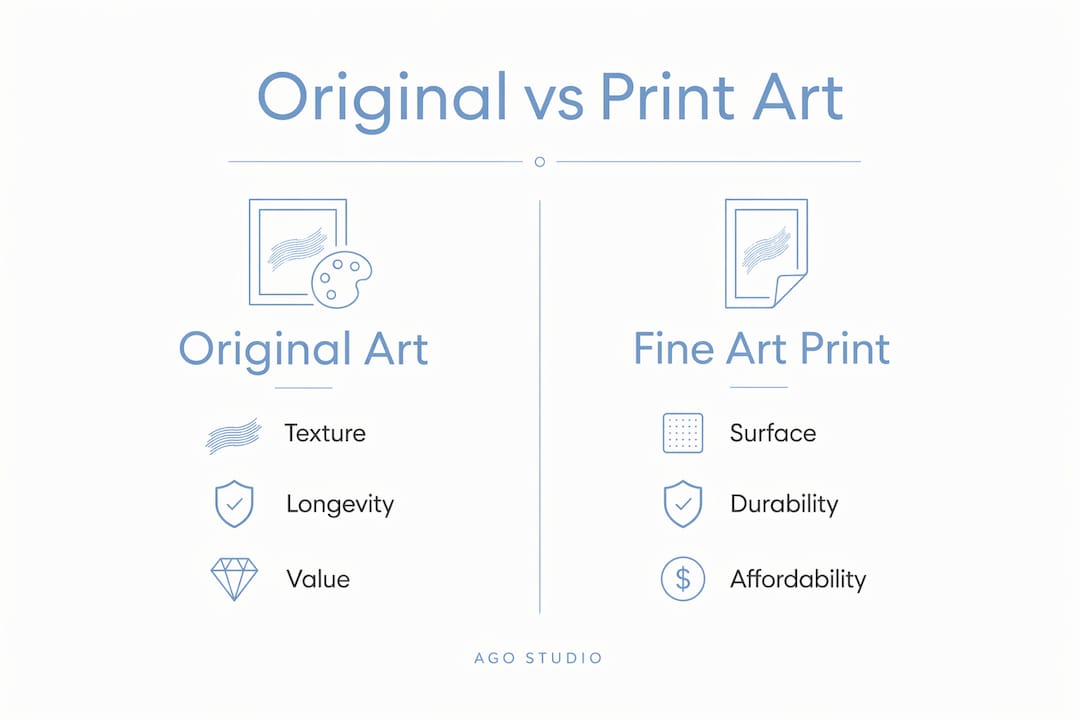
What are the benefits and limitations of buying originals vs prints?
The right choice depends on what you want the art to do for you. Both formats have genuine strengths and real trade-offs.
| Factor | Original Art | Fine Art Print |
|---|---|---|
| Cost | High, often thousands of dollars | Low to moderate, often under $200 |
| Uniqueness | One of a kind | Reproduced, sometimes in limited runs |
| Investment potential | Appreciates with artist’s reputation | Minimal unless limited edition |
| Flexibility | Fixed commitment | Easy to swap, rotate, or replace |
| Emotional impact | Typically stronger tactile connection | Strong visual impact at lower cost |
| Accessibility | Requires larger budget | Accessible to wider audiences |
Original artworks tend to appreciate in value over time, particularly as an artist’s reputation grows. That makes them a legitimate long-term asset, not just a purchase. Prints, by contrast, are primarily decorative. The exception is limited edition prints from established artists, which can hold or grow in value.
Prints solve a real problem for buyers decorating multiple rooms or working with a tight budget. You can fill a hallway, a bedroom, and a home office with quality prints for the cost of a single small original. That flexibility is not a compromise. It is a strategy.
Pro Tip: When buying an original, ask for provenance documentation: the artist’s name, date of creation, and materials used. This information protects your investment and makes future resale far easier.
The emotional dimension is harder to quantify but real. Standing in front of an original painting, knowing no other version of that exact object exists, creates a different experience than looking at a reproduction. Many collectors describe originals as having a presence that prints simply do not carry. That presence is worth paying for when you find the right piece.
How to build a balanced art collection for your living space
The most effective approach to collecting art for a home is to mix originals and prints strategically, using originals as focal points and prints as supporting pieces. This is not a budget compromise. Interior designers and serious collectors use this method deliberately.
Here is how to apply it room by room:
- Anchor each main room with one original. The living room, primary bedroom, or dining room each benefits from a single original artwork placed at eye level on the most visible wall. This piece carries the emotional weight of the space. A resource like Agostudio’s statement wall artwork guide shows how a single strong piece transforms a room.
- Use prints to build out the rest. Hallways, home offices, bathrooms, and secondary bedrooms are ideal for quality prints. They add visual interest without requiring the investment of an original.
- Scale matters more than format. A large giclée print at 40 by 60 inches reads as a statement piece. A small original at 8 by 10 inches reads as an accent. Match the scale of the work to the role you need it to play in the room.
- Frame consistently. Mixing originals and prints in a gallery wall works best when framing is cohesive. Consistent frame color or material unifies pieces regardless of whether they are originals or reproductions. For layout ideas, the gallery wall design guide from Agostudio covers this in detail.
- Rotate prints seasonally. One advantage prints have over originals is replaceability. You can swap prints to reflect a season, a mood, or a design refresh without losing value. Originals stay put.
- Set a collection budget with both formats in mind. A practical split for first-time buyers is to allocate 60–70% of an art budget to one or two originals and use the remainder for prints that complement them.
Key takeaways
Original art and print art each serve a distinct purpose. The smartest buyers use both formats together, letting originals anchor a space and prints fill it out affordably.
| Point | Details |
|---|---|
| Texture is the key test | Originals have raised, tactile surfaces; prints are completely flat under raking light. |
| Magnification confirms prints | A repeating dot or rosette pattern under a loupe means it is a mechanical print, not an original. |
| Limited editions hold value | Signed, numbered limited edition prints occupy a middle ground between originals and open editions. |
| Originals appreciate over time | Original artworks grow in value as an artist’s reputation builds; open edition prints generally do not. |
| Mix both for best results | Use one original as a room’s focal point and quality prints to complete the collection affordably. |
What I’ve learned from living with both originals and prints
I spent years treating originals and prints as competing options. That framing was wrong. The first original I bought for my living room changed the room in a way I did not expect. It was not just the image. It was the object. The texture, the slight imperfections, the knowledge that the artist’s hand had been exactly where I was looking. Prints cannot replicate that.
But prints taught me something originals could not. They gave me permission to experiment. I rotated prints through my home office and bedroom without anxiety. I tried different styles, different color palettes, different scales. That experimentation made me a better buyer when I returned to originals. I knew what I actually wanted on the wall, not just what looked good in a photo.
The mistake most first-time buyers make is treating the original-versus-print decision as permanent. It is not. Start with a print from an artist whose work genuinely moves you. If that connection deepens, find their original work. The print is not a consolation prize. It is often the beginning of a real collecting relationship.
What I tell anyone starting out: do not buy art to fill space. Buy it because something in the piece will not leave you alone. That feeling exists with prints and originals alike. The format matters less than the pull.
— DAVID
Start your collection with Agostudio
Agostudio curates original artworks and fine art prints selected for their emotional depth and authenticity. Every piece in the collection is chosen because it carries something real: a sense of warmth, memory, or presence that transforms a room from decorated to alive. Whether you are ready to invest in your first original or want to build out a space with quality prints, Agostudio’s art prints collection offers a range of styles and price points to match where you are in your collecting journey. For print collectors who want a curated monthly experience, the Artist Print Club delivers handpicked prints from real artists directly to your door.
FAQ
What is the main difference between original art and a print?
An original artwork is a unique, hand-created piece with physical texture and brushstrokes. A print is a mechanical or digital reproduction of that work, with a flat surface and no original paint application.
How do I tell if a painting is an original or a print?
Hold the piece under raking light to check for surface texture, and use a magnifying glass to look for a repeating dot pattern. Originals have irregular pigment distribution; prints always show a mechanical dot or rosette grid.
Are limited edition prints worth buying?
Limited edition prints are signed and numbered in a defined run, which gives them more value than open edition prints. They occupy a middle ground between originals and unlimited reproductions and can hold value over time.
Should I buy prints or originals for my home?
The most effective approach is to use one original as the focal point of a main room and complement it with quality prints in secondary spaces. This balances emotional impact with budget flexibility.
Do original artworks increase in value?
Original artworks tend to appreciate as an artist’s reputation grows, making them a legitimate long-term asset. Open edition prints are primarily decorative and do not typically increase in value.