

Art on a budget without compromising quality is defined as achieving gallery-worthy home decor through archival-quality prints, smart framing choices, and cohesive design arrangements that cost a fraction of original artwork prices. Gallery markups on original art often reach 300–500%, which means a piece priced at $500 in a gallery may have cost the artist $100 to produce. That gap is your opportunity. Affordable art solutions like giclée prints, print-on-demand canvas, and curated digital downloads deliver the same visual punch at a dramatically lower price. The key is knowing where to spend, where to save, and how to arrange what you buy.
What are affordable art options that maintain quality and style?
The most effective budget-friendly artwork formats are archival-quality fine art prints, canvas prints, and digital downloads. Each delivers lasting color, sharp detail, and a professional finish without the price tag of an original.
Archival fine art prints (also called giclée prints) use pigment-based inks on acid-free paper. They resist fading for decades, which makes them a genuine long-term investment. A fine art photo print on archival paper costs $10–$20. That is a fraction of what a framed original commands.
Print-on-demand canvas services let you upload an image and receive a stretched canvas print within days. The result looks like an original painting from across a room. Sizes, finishes, and substrates are fully customizable, so you get exactly what fits your wall.
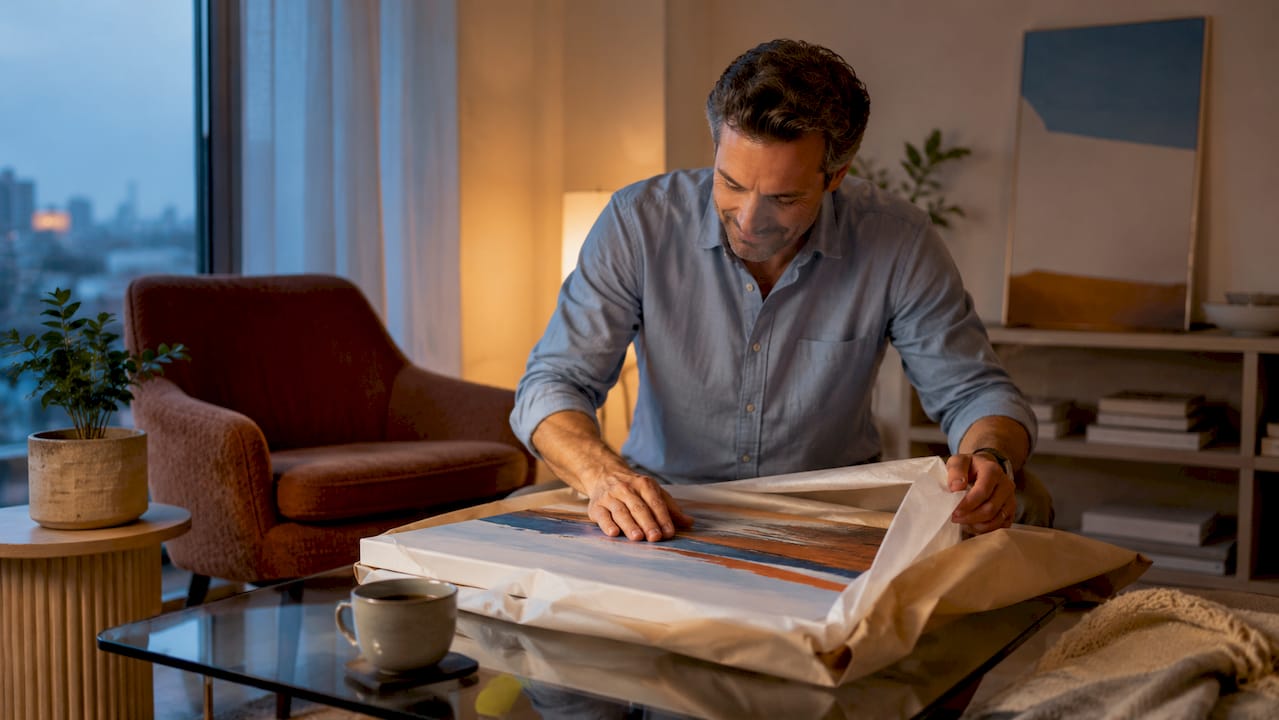
AI-generated and digital art open another door. AI tools generate unique artwork in dozens of styles for a low-cost digital file you can print on canvas or archival paper for $10–$50. This works especially well for buyers who want something personal and one-of-a-kind without commissioning an artist.
Museum open-access collections are an underused resource. Institutions like the Metropolitan Museum of Art and the Rijksmuseum offer thousands of high-resolution public domain images free to download and print legally. You can print a Vermeer on archival paper for the cost of the paper itself.
- Giclée prints on acid-free paper for lasting color
- Print-on-demand canvas for a painted look at low cost
- AI-generated digital files for personalized, unique pieces
- Public domain museum images for free, legal high-resolution art
- Digital downloads from reputable marketplaces for instant delivery
Pro Tip: When ordering prints online, always request a color proof or check the printer’s ICC profile. Screens display color differently than paper, and a small test print saves you from a costly full-size disappointment.
How to save on framing without losing quality or style?
Framing is where most buyers unknowingly spend the most money. Custom framing markups range from 200–400%, and a single framed piece can cost more than the art itself. The fix is straightforward: use standard frame sizes.
Standard sizes like 16x20, 18x24, and 24x36 inches are mass-produced, which drives prices down. Retailers stock frames in these dimensions at $25–$45, and the quality is solid. Choosing art that fits these sizes from the start eliminates the need for custom cutting entirely.
- Choose standard dimensions first. Size your art to 16x20, 18x24, or 24x36 before you print. This single decision removes the biggest cost driver in framing.
- Shop retail frame sections. Stores like IKEA and Michaels carry quality frames in standard sizes at $25–$45. The IKEA RIBBA series, in particular, includes a mat and a clean profile that works in almost any room.
- Hunt thrift stores for vintage frames. Thrift store frames spray-painted for cohesion cost $1–$5 and look professional once unified in color. Matte black, white, or warm gold are the most versatile choices.
- Add a mat board. A simple white or cream mat makes any print look more finished. It also lets you use a slightly larger frame for a smaller print, which adds visual weight without extra cost.
- Stick to one or two frame colors. Mixing too many finishes fragments a wall. Consistency in frame color is the single fastest way to make budget frames look intentional and curated.
Stat to know: Total per-piece cost including framing can be $15–$35 using off-the-shelf frames. A comparable custom-framed piece at a gallery often runs $150–$300 or more.
Pro Tip: Buy a can of matte spray paint in your chosen frame color and use it on every thrift-store find. One consistent finish across mismatched frames creates a gallery wall that looks planned, not assembled.
What design principles help maximize art impact on a budget?
The biggest mistake budget buyers make is purchasing one large, expensive piece when a grouped arrangement of smaller prints delivers more impact. Grouping 3–5 smaller coordinated prints creates more visual interest than a single statement work. The eye moves across a gallery wall, which makes the overall display feel richer and more considered.
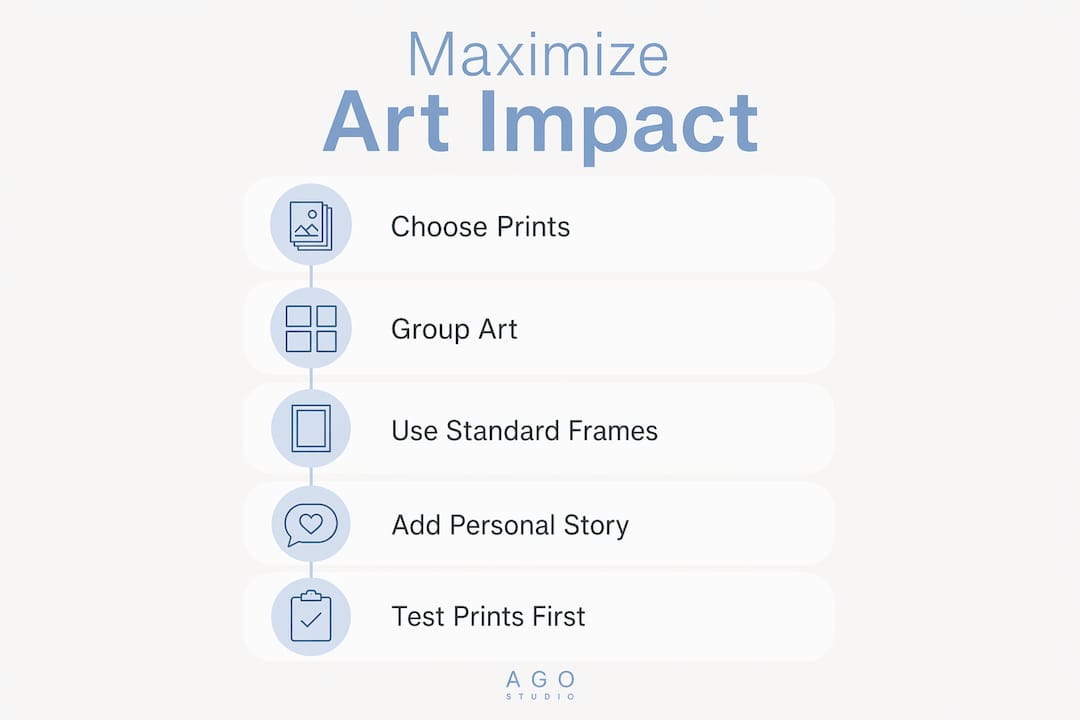
Color palette is the second most powerful tool. Neutral palettes with subtle color accents offer decorating flexibility and reduce replacement costs when you redecorate. A monochromatic scheme combining abstracts, photography, and botanical studies creates unity across very different subjects. You can swap one piece in or out without disrupting the whole wall.
Scale matters more than most buyers realize. Art that is too small for a wall looks like an afterthought. Art that is too large overwhelms the room. A general rule: the art arrangement should cover roughly two-thirds of the wall width above a sofa or console.
- Group by theme or palette, not by price. A $15 botanical print and a $12 abstract can share a wall beautifully when they share a color.
- Use consistent spacing. Two to three inches between frames reads as intentional. Uneven gaps make even expensive art look careless.
- Mix orientations. Combining portrait and landscape frames within a gallery wall adds rhythm and prevents the arrangement from feeling rigid.
- Anchor with one larger piece. Even in a budget gallery wall, one slightly larger print at the center gives the eye a place to land.
For room-specific ideas on how to arrange pieces by scale and wall size, the wall art arrangement guide at Agostudio covers practical layouts for every room type.
| Design principle | Why it works |
|---|---|
| Gallery grouping (3–5 prints) | Creates visual movement and fills space more effectively than one piece |
| Neutral palette with accents | Allows flexibility when updating decor without replacing all art |
| Consistent frame color | Unifies mismatched or budget frames into a cohesive display |
| Two-thirds wall width rule | Prevents art from looking too small or too large for the space |
How to source and print custom affordable art that suits your style?
Sourcing quality art for less starts with choosing the right print service. Not all printers use the same paper or ink, and the difference shows on your wall.
- Choose a printer that specifies archival materials. Services like Mpix and local fine art print shops use pigment-based inks and acid-free paper. These materials resist yellowing and fading far longer than standard photo prints.
- Compare paper types before ordering. Matte paper suits botanical and line-art prints. Lustre or semi-gloss paper works well for photography. Canvas is best for abstract or painterly subjects. Each finish changes how color and texture read in a room.
- Download high-resolution files from reputable sources. Resolution below 300 DPI at print size produces visible pixelation. Always confirm the file resolution before purchasing a digital download.
- Preview art in your actual space before printing. Visualization tools show paintings virtually in your room before you commit to printing or purchasing. This step alone prevents the most common and costly mistake: wrong size.
Concentrating your budget on one quality medium produces better results than spreading it across many low-quality pieces. Buy two excellent archival prints rather than six cheap ones. The difference in longevity and visual quality is significant.
For buyers weighing the choice between prints and originals, the original vs. print art guide at Agostudio breaks down the value comparison clearly for first-time buyers.
Pro Tip: Order a 5x7 test print of any digital file before committing to a large format. It costs under $2 and reveals color accuracy, paper texture, and any resolution issues before you spend on a 24x36 print.
Key takeaways
Affordable art decor succeeds when you prioritize archival print quality, standard frame sizes, and cohesive grouping over spending more on a single expensive piece.
| Point | Details |
|---|---|
| Gallery markups are avoidable | Fine art prints on archival paper cost $10–$20 versus hundreds for originals. |
| Standard frames cut framing costs | Sizing art to 16x20 or 18x24 keeps framing costs at $25–$45 per piece. |
| Grouping beats single statements | Three to five coordinated prints create more visual impact than one expensive work. |
| Palette consistency unifies budget art | A neutral base with color accents lets you mix print types without visual chaos. |
| Test before you print large | A small proof print confirms color and resolution before a costly large-format order. |
What I’ve learned about buying art without overspending
The conventional advice is to save up for one great piece. I disagree with that completely.
One piece, no matter how good, rarely transforms a room the way a considered arrangement does. The rooms that stop people in their tracks are almost always gallery walls: layered, personal, and built over time. None of those walls required a single expensive purchase.
What I’ve seen work consistently is collecting art with a personal story or cultural connection. A print that reminds you of a place you visited, a subject you love, or an artist whose work genuinely moves you carries more weight than a piece chosen because it was impressive or costly. That intangible value is real. Guests respond to it. You respond to it every morning.
The pitfall I see most often is overbuying. Buyers find a sale, grab six prints, and end up with a wall that looks cluttered and random. Well-printed archival-quality prints framed thoughtfully deliver the same visual impact as expensive originals. Two of those, placed well, beat six mediocre ones every time.
Spend on materials, not volume. Choose a consistent frame color before you buy a single frame. And treat your wall as a story you are telling slowly, not a problem to solve in one afternoon.
— DAVID
Agostudio’s curated prints for budget-conscious decorators
Agostudio curates archival-quality art prints across a range of themes, sizes, and styles, all selected for their ability to transform a room without requiring a large investment. Each print is chosen for its visual depth and the story it carries, which means you are not just filling wall space.
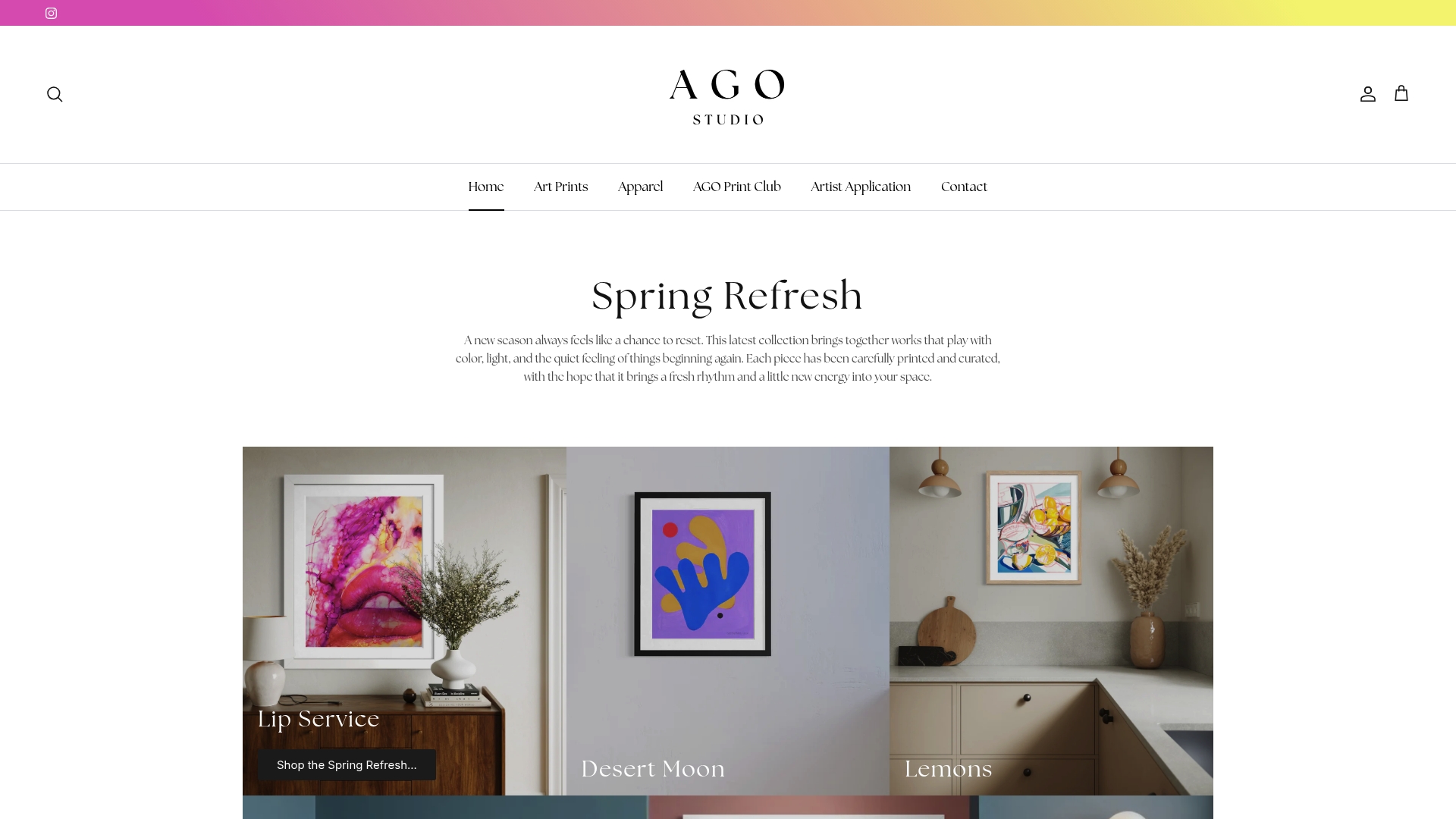
The Artist Print Club offers a subscription model that delivers curated prints on a regular schedule, making it easy to build a cohesive collection over time at a predictable cost. For first-time buyers, Agostudio’s team is available to help with sizing, framing suggestions, and arrangement ideas so you get it right the first time.
FAQ
What is art on a budget?
Art on a budget means sourcing quality artwork, typically archival prints or digital downloads, at a fraction of original art prices by using smart print services, standard frame sizes, and cohesive grouping strategies.
Does affordable art look cheap compared to originals?
Not when printed on archival paper and framed well. Well-printed giclée prints framed in standard retail frames are visually indistinguishable from framed originals at typical viewing distances.
What is art gifting on a budget?
Art gifting on a budget covers options from digital downloads under $20 to museum-quality prints above $150. Presentation and a personal connection to the subject elevate an affordable print into a genuinely meaningful gift.
What frame sizes save the most money?
Standard sizes like 16x20, 18x24, and 24x36 inches eliminate custom framing costs. Retail frames in these sizes run $25–$45, compared to $150–$300 or more for custom framing.
How many prints do I need for a gallery wall?
Three to five coordinated prints create a gallery wall with strong visual impact. Consistent frame color and two-to-three-inch spacing between frames make the arrangement look intentional regardless of what each print cost individually.