

Large scale original paintings are defined as single or multi-panel artworks spanning at least 24 inches in their smallest dimension, designed to serve as the primary visual anchor of a room. The best types of large scale original paintings fall into distinct categories: abstract expressionism, minimalist fields, photorealist canvases, and multi-panel series. Each type interacts with space differently, and choosing the wrong one for your wall is the most common mistake homeowners make. Scale, composition, and thematic focus determine whether a painting commands a room or simply decorates it.
1. Types of large scale original paintings: the core categories
Large scale original paintings divide into four primary categories based on technique and composition. Abstract expressionist works use gestural marks and raw color to create emotional intensity. Minimalist paintings rely on restraint and negative space. Photorealist canvases reproduce scenes with near-photographic detail. Thematic series spread a single narrative across multiple panels. Each category suits different rooms, moods, and wall dimensions.
Abstract expressionism originated in 1940s New York and remains the most influential large canvas style for bold modern interiors. Its gestural marks and emotional intensity make it the strongest choice for living rooms with high ceilings and neutral walls. Minimalist paintings work best in spaces where the architecture already speaks loudly. Photorealism suits hallways and dining rooms where viewers can stand close enough to appreciate detail.

2. Abstract expressionist paintings
Abstract expressionism is the dominant style in contemporary large scale art. Artists like Mark Rothko and Franz Kline built entire careers on the idea that scale amplifies emotion. A 60-inch color field painting does not just hang on a wall. It changes the temperature of the room.
The technique relies on layered paint application, often with palette knives, wide brushes, or poured pigment. That texture catches light differently throughout the day, which means the painting looks different at 9 AM than it does at 8 PM. Lighting and surrounding empty space are integral parts of the composition, transforming how color and texture read from across the room. Soft evening light deepens warm tones; bright daylight flattens them.
Pro Tip: Place an abstract expressionist canvas on a wall that receives indirect natural light. Direct sunlight bleaches pigment and flattens the textural depth that makes these works compelling.
3. Minimalist large canvas paintings
Minimalist paintings prove that restraint is a form of power. A single color field, a thin horizon line, or a spare geometric form on a large canvas creates more visual tension than a busy composition. Visual power in statement wall art comes from singular focus, not complexity. One motif executed with precision holds more lasting impact than a crowded scene.
Minimalist works suit open-plan living rooms, bedrooms, and home offices where the goal is calm rather than drama. They pair well with Scandinavian and Japanese-influenced interiors. The Minimalist Flowers collection at Agostudio demonstrates how a restrained motif on a large canvas can anchor a room without competing with furniture or architecture.
4. Photorealist and figurative large paintings
Photorealism at large scale creates a fundamentally different experience than abstract work. A 48-inch portrait or landscape rendered in precise detail draws viewers in rather than pushing them back. The eye wants to search the surface for information. That searching quality makes photorealist paintings ideal for spaces where people linger, such as dining rooms, libraries, and reading nooks.
Figurative paintings, which include portraits, figure studies, and narrative scenes, carry the added weight of human presence. A large figurative work in a living room becomes a conversation piece in a way that abstract art rarely does. The subject matter invites questions about the artist, the sitter, and the story behind the image.
5. Diptych paintings
A diptych is a two-panel painting where both canvases form a single unified image or a paired thematic statement. The format suits wide walls where a single canvas would look undersized. Equal-panel diptychs work well in minimalist interiors because the symmetry reinforces the room’s geometry.
Spacing between panels is the most technically critical decision in diptych installation. A 2–4 cm gap allows the eye to read both panels as one continuous image. A 5–8 cm gap signals that the panels are thematically related but visually independent. Wider gaps than 8 cm break the connection entirely and the work reads as two separate pieces.
6. Triptych paintings
Triptychs are the most popular multi-panel format for large scale original paintings in residential spaces. Three panels offer compositional flexibility that a single canvas cannot match. The center panel can carry the dominant image while the flanking panels provide context, or all three panels can share equal visual weight.
Center-weighted triptychs complement traditional and transitional interiors. Equal-weight triptychs suit minimalist and contemporary aesthetics. The format also solves a practical problem: three narrower panels are easier to transport and hang than one very wide canvas. For rooms with a sofa or console table as the anchor furniture, a triptych hung horizontally above it creates the most balanced composition.
Pro Tip: Hang the center panel of a triptych at eye level, approximately 57–60 inches from the floor to the center of the canvas. The flanking panels follow that same centerline.
7. Pentaptych and grid arrangements
A pentaptych uses five panels and is the format of choice when a wall is wide enough to require more than three canvases but the homeowner wants a single unified artwork rather than a gallery wall. Grid arrangements, typically 2x2 or 3x2, work differently. They impose a structured, architectural quality on the wall.
Grid formats suit industrial and modern interiors where geometry is already a design theme. Thematic series in multi-panel art require palette and mood consistency across every panel. Without that consistency, a grid reads as a collection of unrelated prints rather than a single curated work. The difference between a gallery wall and a pentaptych is intentionality: every panel in a pentaptych serves the same visual argument.
8. Thematic series paintings
A thematic series is a group of paintings connected by subject, palette, or emotional tone rather than a single split image. Botanical series, landscape sequences, and figure studies in varied poses all qualify. The series format gives homeowners flexibility: panels can be displayed together or distributed across different rooms.
Coordinated thematic series require palette and mood consistency across panels for visual harmony. That consistency is what separates a curated series from a random collection. When the colors and emotional register stay constant, the eye accepts the panels as a single artistic statement even when they hang in different rooms.
9. Single large canvas paintings
A single large canvas is the most direct statement a homeowner can make. Artwork should occupy at least half the wall’s visual width to function as a true focal point rather than decoration. A canvas that is too small for its wall looks like an afterthought regardless of its quality.
Single large canvases provide continuous scene viewing suited for landscapes or abstract color fields. Multi-panel series offer flexibility for varied compositions and thematic narratives. The choice between them depends on wall width, room function, and whether the homeowner wants a single dramatic gesture or a more layered visual experience.
“The strongest statement art depends on a single dominant visual idea and appropriate scale relative to wall size. Complexity is not a substitute for presence.”
How to choose large scale original paintings for your living space
Scale is more critical than content. An oversized canvas dominates a space and establishes focal identity more effectively than intricate detail on a smaller work. Measure your wall before selecting any artwork. The painting’s width should cover at least half the wall’s horizontal span, and ideally two-thirds.
Lighting and empty space around the painting are not afterthoughts. Empty space acts as a frame, letting the artwork command attention without competition. Avoid hanging large paintings directly above furniture that crowds the lower edge of the canvas. Leave at least 6–8 inches between the top of a sofa or console and the bottom of the frame.
Pro Tip: Before committing to a painting, tape a paper template of the canvas dimensions to your wall and live with it for two days. The template reveals whether the scale feels right in different lighting conditions.
Common mistakes to avoid:
- Hanging artwork too high. The center of the canvas should sit at eye level, not at ceiling height.
- Choosing a painting based on color matching alone. Color is one factor; scale, texture, and composition matter equally.
- Ignoring viewing distance. Abstract and minimalist works need space to breathe. Plan for at least 8–10 feet of viewing distance for canvases over 48 inches wide.
- Mixing panel gaps inconsistently across a multi-panel set. Uniform gaps signal intentionality.
Comparing single canvas and multi-panel large paintings
Single canvas versus multi-panel formats each carry distinct strengths depending on the room and the homeowner’s aesthetic goals.
| Feature | Single large canvas | Multi-panel set |
|---|---|---|
| Visual effect | Continuous, unified image | Layered, segmented narrative |
| Installation complexity | Low | Moderate to high |
| Transport and handling | Difficult for very wide pieces | Easier per panel |
| Best decor styles | Minimalist, contemporary, maximalist | Modern, eclectic, transitional |
| Flexibility | Fixed composition | Panels can be rearranged |
| Spatial requirement | Needs one uninterrupted wall | Adapts to broken wall layouts |
Multi-panel sets solve the practical problem of very wide walls where a single canvas would need to be custom-built at significant cost. They also allow homeowners to expand a series over time. A diptych can become a triptych when a new panel is commissioned from the same artist.
Key takeaways
The most impactful large scale original paintings combine appropriate scale, a single dominant visual idea, and consistent spacing or thematic coherence across panels.
| Point | Details |
|---|---|
| Scale before content | The painting’s width should cover at least half the wall’s horizontal span. |
| Spacing determines unity | Use 2–4 cm gaps for continuous images; use 5–8 cm gaps for thematic series. |
| Style matches room function | Abstract expressionism suits living rooms; photorealism works best in dining rooms and libraries. |
| Lighting is part of the composition | Indirect natural light preserves texture and color depth in large canvases. |
| Single vs. multi-panel | Single canvases deliver unified impact; multi-panel sets offer flexibility and narrative range. |
Why scale and restraint matter more than style
I have worked with enough large-format art to say this clearly: most homeowners underestimate scale and overestimate complexity. They choose a painting they love at gallery size and hang it on a wall that dwarfs it. The painting disappears. The room wins.
The pieces that hold a room over years are almost always the ones with a single strong idea. A vast blue field. A spare botanical. A gestural mark that fills the canvas without explaining itself. Thematic clarity is what separates art that defines a space from art that merely occupies it.
Lighting is the variable most people ignore entirely. I have seen the same painting look flat and forgettable under overhead fluorescents and genuinely moving under a warm directional light. The artwork did not change. The light did. If you invest in a large original, invest equally in how you light it. A picture light or a recessed spot aimed at the canvas returns more value than any frame upgrade.
My honest advice: buy one painting that is slightly larger than you think you need, hang it lower than feels instinctive, and light it from above at a 30-degree angle. That combination works in almost every room I have seen it applied to.
— DAVID
Original large scale art at Agostudio
Agostudio curates original artworks and large-scale art prints selected for their emotional resonance and spatial impact. Every piece in the collection is chosen because it holds a room, not just fills a wall.
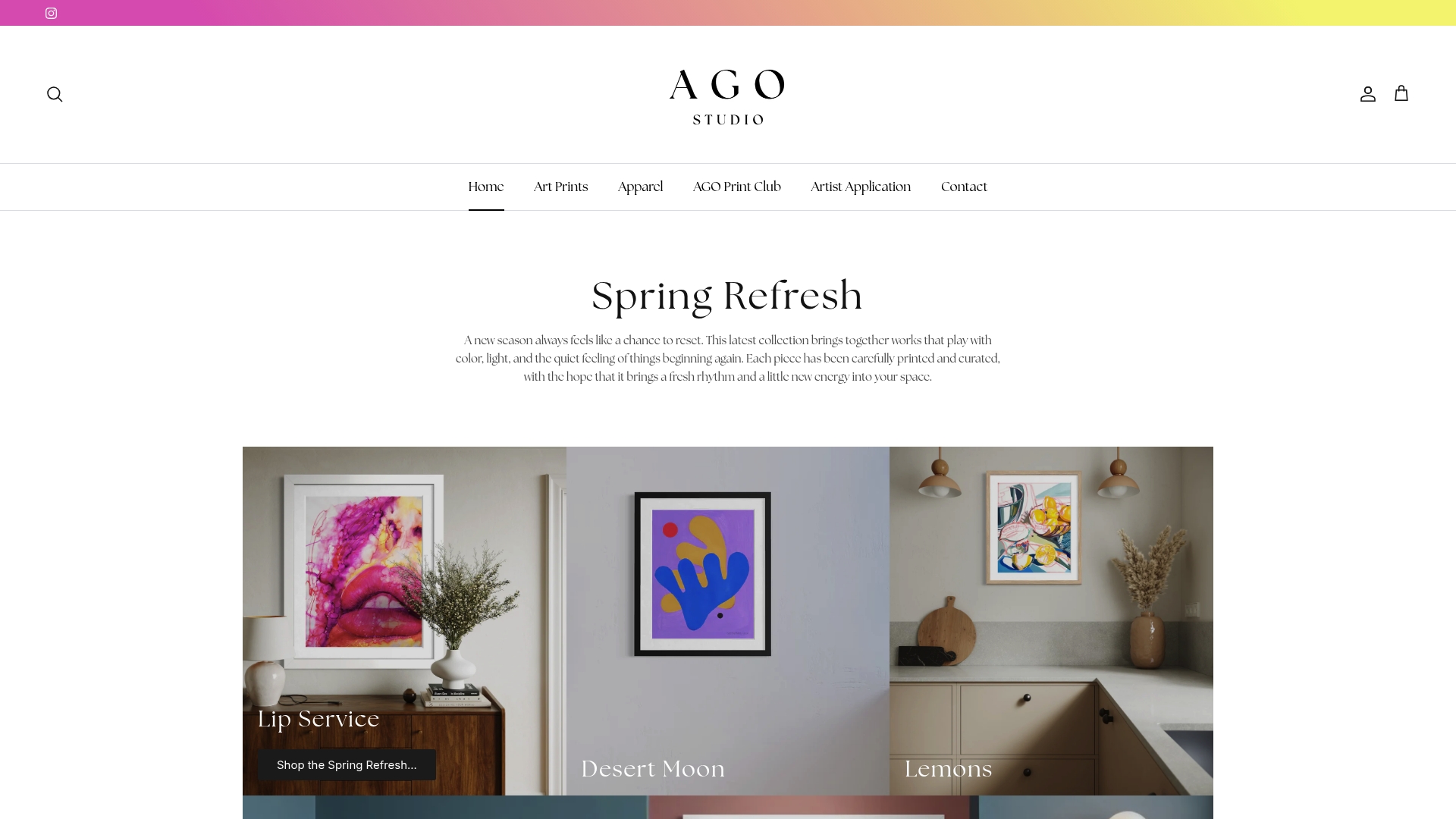
The Artist Print Club gives collectors access to a rotating selection of large-format originals and series prints, including abstract landscapes and thematic botanical sets. Whether you are furnishing a living room or anchoring a dining space, Agostudio’s collection covers the full range of formats, from single statement canvases to coordinated multi-panel sets, all vetted for quality and authenticity.
FAQ
What size counts as large scale for original paintings?
A painting is generally considered large scale when its smallest dimension exceeds 24 inches. Works over 40 inches wide function as primary focal points in most residential rooms.
What are the most popular types of large scale original paintings for living rooms?
Abstract expressionist canvases and triptychs are the most popular choices for living rooms. Both formats provide the scale and visual weight needed to anchor a seating area.
How far apart should panels be in a multi-panel painting?
Use a 2–4 cm gap between panels for a continuous image, and a 5–8 cm gap for thematic series. Gaps wider than 8 cm break visual cohesion between panels.
Does a large painting need special lighting?
Large paintings benefit significantly from directional lighting. A picture light or recessed spot aimed at the canvas at a 30-degree angle reveals texture and prevents the work from appearing flat under ambient room light.
What is the difference between a thematic series and a split-image multi-panel?
A split-image multi-panel divides one continuous image across several canvases. A thematic series groups related but independent paintings connected by palette, subject, or emotional tone.