

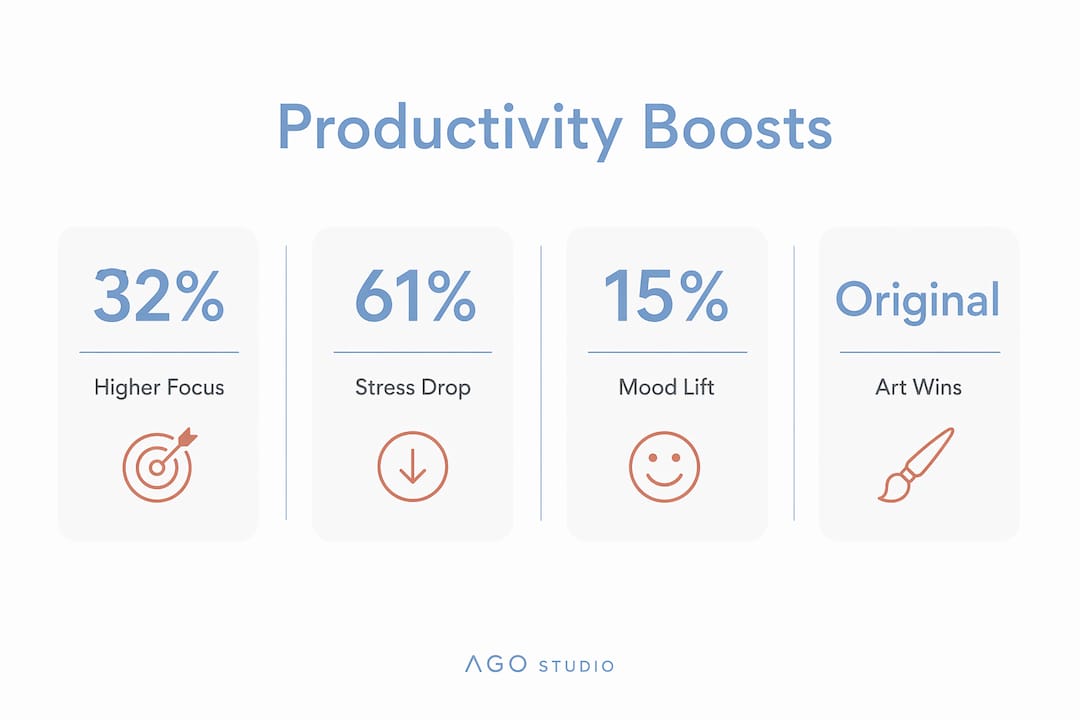
The role of art in home office environments extends far beyond decoration. Art actively shapes your mood, sharpens cognitive function, and directly influences how well you work. Research from the University of Exeter confirms that art-enriched workspaces produce productivity gains between 15% and 32%. That number alone should change how you think about your walls.
How does art in your home office affect productivity?
Art is a performance tool, not just a visual preference. Visual enrichment in work environments improves mood, reduces stress, and speeds up information processing. These are measurable outcomes, not abstract feelings.
The University of Exeter research goes further. Workers in art-rich spaces showed cortisol reduction up to 61% compared to those in bare offices. Cortisol is the primary stress hormone. Lower cortisol means clearer thinking, better decisions, and less burnout over a long workday.
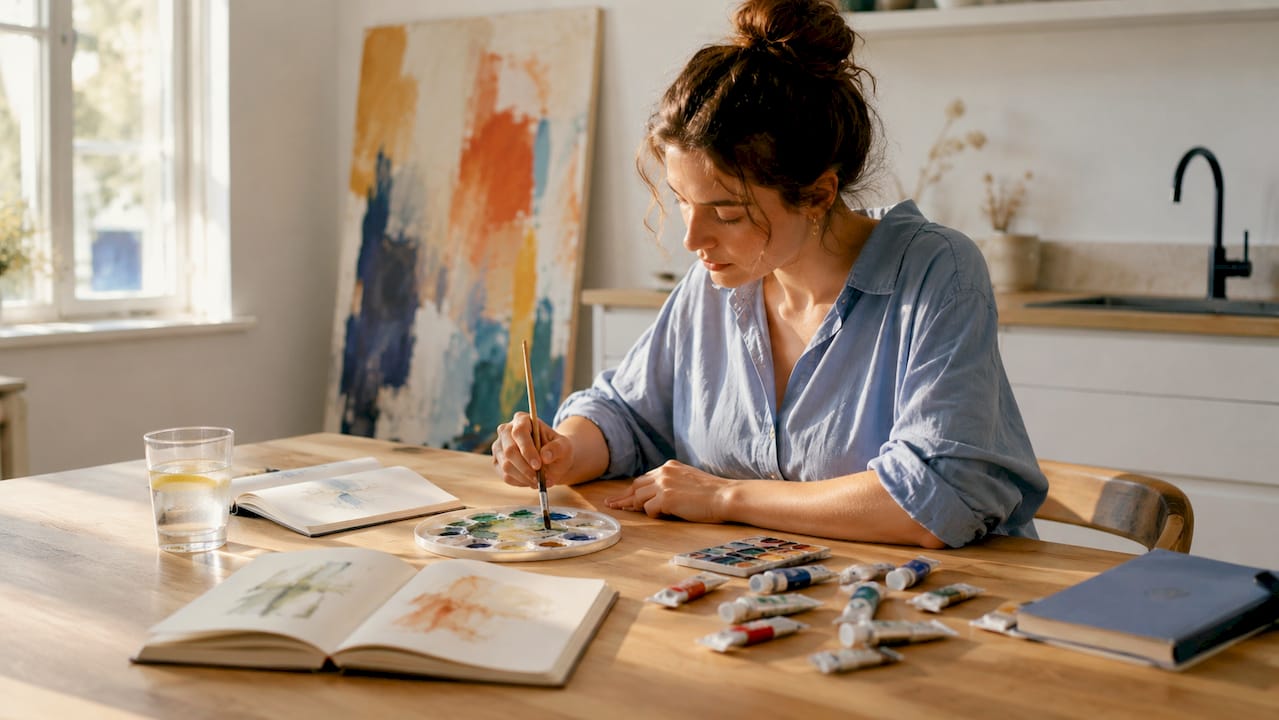
Environmental psychologist Dr. Craig Knight explains the mechanism. The human nervous system is biologically wired for organic complexity. Sterile, blank walls create low-grade stress that compounds across hours. Natural, textured, and visually layered art gives the nervous system something to process and recover from that background tension.
Art also provides what researchers call “momentary distraction.” A glance at a painting during a difficult task is not wasted time. Art enhances focus and creativity by giving the brain a brief reset before returning to work. Think of it as a micro-break that costs you nothing.
“Art acts as a visual language adding depth and individuality, essential for personalizing any remote work environment.” — Interior design and cultural expert analysis, Times of India
Pro Tip: Place one piece of art directly in your peripheral vision rather than straight ahead. Your brain registers it during mental pauses without pulling focus from your screen.
What art styles work best for focus and calm?
Not every piece of art helps you work better. Some actively make concentration harder. High-contrast, text-heavy, or busy figurative art increases cognitive load and pulls attention away from the task in front of you. The wrong art is worse than no art at all.
The styles that consistently support focus share a few qualities:
- Abstract and organic forms: These engage the eye without demanding interpretation. Your brain processes them passively, which is exactly what you want during deep work.
- Nature-inspired imagery: Landscapes, botanicals, and water scenes tap into the same nervous system recovery that Dr. Craig Knight describes. They feel familiar and calming without being boring.
- Muted palettes: Soft blues, warm greens, and neutral earth tones lower visual arousal. Bright reds and high-saturation colors do the opposite.
- Minimal text or narrative: Art that tells a complex story competes with your own thinking. Quiet, open compositions give your mind room to breathe.
Interior designer Namrata Saigal makes a point worth taking seriously. Emotionally resonant original art creates environments that feel alive and support resilience during long, isolating remote work hours. Mass-produced prints and AI-generated images lack that quality. They fill space without creating connection.
Research backs this up. Original handmade canvas paintings show stronger positive effects on productivity and mood than prints or mass-produced alternatives. The difference is not just aesthetic. Authenticity registers psychologically.
When decorating your home office with art, trust your gut reaction to a piece. If it makes you feel settled and curious at the same time, it belongs in your workspace. If it demands your attention or makes you feel anxious, it belongs somewhere else.
Pro Tip: Choose art with a matte finish rather than glossy. Glossy surfaces reflect screen light and overhead lighting, creating glare that causes eye strain over a full workday.
Does art placement change how well it works?
Where you hang art matters as much as what you hang. The professional design standard places art at 57%–62% of wall height from the floor. That range aligns with seated eye level, which is where your gaze naturally rests during a workday. Hanging art at standing eye level forces your eyes upward and creates visual strain you may not even notice consciously.
Scale and coverage also shape the experience of your workspace. Professional designers recommend dedicating 30%–40% of visible wall area to art. Too little and the space feels sterile. Too much and it becomes visually overwhelming, which defeats the purpose entirely.
The table below compares common placement strategies and their practical effects:
| Placement Strategy | Best For | Effect on Focus | Key Consideration |
|---|---|---|---|
| Single large statement piece | Small or minimal offices | High calm, low distraction | Keep it in peripheral view |
| Gallery wall arrangement | Larger dedicated office rooms | Moderate; depends on cohesion | Use consistent frames and palette |
| Art beside or behind monitor | Video call backgrounds | Adds personality without distraction | Avoid busy or high-contrast pieces |
| Art on a side wall | Deep focus environments | Low distraction, high ambient benefit | Ideal for abstract or nature-inspired work |
For guidance on choosing between a gallery wall and a single statement piece, Agostudio’s design comparison guide breaks down the tradeoffs clearly.
Pro Tip: Use a picture light or adjustable track lighting aimed at your art rather than relying on overhead room light. This eliminates glare and makes the piece look intentional rather than incidental.
Can art support your emotional well-being while working remotely?
Remote work is isolating in ways that office environments are not. You lose the ambient energy of other people, the visual variety of a commute, and the informal social moments that break up the day. Art fills some of that gap in ways that furniture and technology simply cannot.
Cultural and design expert Anoop Srivastava describes art as a visual language that reflects identity and values. When you choose art that genuinely means something to you, your workspace becomes an expression of who you are. That matters more when you spend eight or more hours a day in the same room.
The emotional benefits of meaningful art in a home office include:
- Reduced isolation: Art that connects to personal memories, places, or values creates a sense of continuity with the world outside your desk.
- Improved resilience: Namrata Saigal’s research shows that emotionally alive environments help workers recover from setbacks faster during the workday.
- Stronger identity: Your workspace communicates something about you, even on video calls. Art signals care, taste, and intentionality.
- Sustained motivation: Generic decor fades into the background within days. Art you genuinely love continues to register and lift your mood over time.
Policy researchers studying art, productivity, and human capital find that art builds empathy and cognitive openness. Both qualities directly support creative problem-solving and conflict resolution, skills remote workers use constantly without the benefit of in-person collaboration.
Learning how to express personality through art is not a soft skill. It is a practical one that shapes how you feel about your work environment every single day.
Key takeaways
Art in a home office is a functional investment in focus, mood, and sustained performance, not a decorating afterthought.
| Point | Details |
|---|---|
| Art boosts productivity measurably | University of Exeter research shows 15%–32% productivity gains in art-enriched workspaces. |
| Style selection matters | Abstract, nature-inspired, and muted-palette art supports focus; busy or high-contrast pieces increase cognitive load. |
| Placement follows seated eye level | Hang art at 57%–62% of wall height to align with where your gaze naturally rests while working. |
| Original art outperforms mass-produced | Handmade and emotionally resonant pieces create stronger psychological benefits than generic prints. |
| Rotation prevents adaptation fatigue | Refreshing your art periodically maintains the mental stimulation benefits over the long term. |
What i’ve learned about art and the home office
Most articles on this topic treat art like a productivity hack. Pick the right color palette, hang it at the right height, and watch your output improve. That framing is not wrong, but it misses the deeper point.
The art that has genuinely changed how I feel about working from home is not the piece I chose because it was “calming.” It is the piece that stopped me mid-scroll when I first saw it. The one that felt like it was made for a version of me I was still becoming. That kind of connection does not show up in a cortisol study, but it shows up every morning when I sit down to work.
The mistake I see remote workers make most often is treating art selection like a checklist. Muted tones? Check. Nature-inspired? Check. Correct height? Check. The result is a workspace that looks considered but feels hollow. Art chosen purely for its functional properties rarely delivers the emotional lift that makes a real difference over months and years of remote work.
My honest advice: buy the piece that makes you feel something specific, not the piece that seems appropriate. Appropriate art blends in. Art that moves you becomes part of how you think.
Also worth saying: you do not need to commit permanently. Rotating art every few months, whether through a print club or simply moving pieces between rooms, keeps your environment fresh and your brain engaged. Consistent rotation of artwork prevents the adaptation fatigue that turns even great art invisible over time.
— DAVID
Find art that actually works for your home office
If you have been working with bare walls or placeholder prints, the research makes a clear case for changing that. Agostudio curates original artworks selected specifically for emotional resonance and authentic human expression. These are not mass-produced catalog pieces. They are works by real artists that hold up over time.
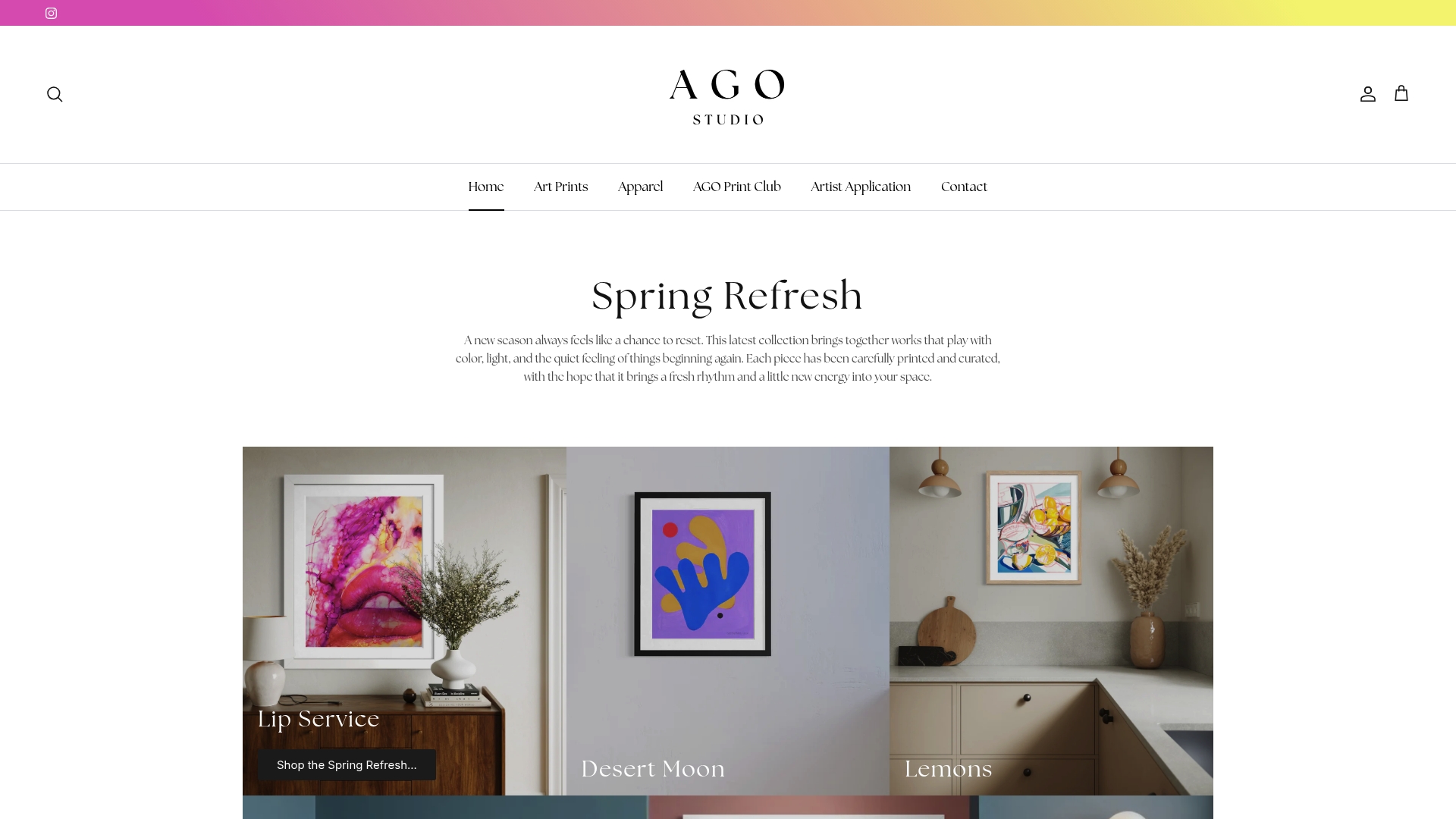
Browse Agostudio’s curated art prints to find pieces suited to focus, calm, and personal expression. For remote workers who want their workspace to evolve, the Agostudio Artist Print Club delivers rotating original prints on a schedule that keeps your environment mentally stimulating. Each tier offers a different level of access, from the Tier 1 entry option to the Tier 3 full collection. Your walls should work as hard as you do.
FAQ
How much does art actually improve work productivity?
University of Exeter research shows productivity gains of 15%–32% in art-enriched workspaces. Workers in those same environments also show cortisol reductions of up to 61%, meaning less stress and clearer thinking throughout the day.
What art style is best for a home office?
Abstract, nature-inspired, and muted-palette artwork supports focus best. High-contrast, text-heavy, or visually busy pieces increase cognitive load and compete with your concentration.
Where should i hang art in my home office?
Hang art at 57%–62% of wall height from the floor. That range aligns with seated eye level and prevents the visual strain that comes from art hung too high.
Does original art work better than prints?
Research shows original handmade canvas paintings produce stronger effects on productivity and mood than mass-produced prints. Emotionally resonant original art creates a sense of connection that generic decor does not replicate.
How often should i change my home office art?
Rotating art every few months prevents adaptation fatigue, the point where your brain stops registering a familiar piece. Membership in an artist print club is one practical way to keep your workspace visually fresh without constantly purchasing new work.