

Art supports mental health by directly activating the brain’s emotional regulation centers and reducing stress hormones through both creative expression and passive exposure. This is not a soft claim. Research from UCL professor Daisy Fancourt states that if art were a drug, it would be prescribed daily worldwide for its measurable reductions in depression, chronic pain, and dementia risk. Whether you pick up a paintbrush or simply hang a meaningful print on your wall, the mental health benefits of artistic engagement are real, physiological, and accessible to everyone regardless of skill level.
Why art supports mental health at the brain level
The science behind art’s mental health benefits starts with two key brain systems: the prefrontal cortex and the Default Mode Network (DMN). The prefrontal cortex handles emotional regulation and decision-making. The DMN governs self-referential thinking, the mental loop that drives rumination and depression.
Art therapy modulates the brain’s Default Mode Network, enabling trauma processing and emotion regulation at neurological, psychological, and cultural levels simultaneously. This reconfiguration is significant because it directly interrupts the negative thought patterns that define depression and anxiety. Think of it as rerouting a traffic jam in your mind.
On the physiological side, creative activities trigger dopamine release while reducing cortisol, heart rate, and blood pressure. Dopamine is the brain’s reward signal. Lower cortisol means lower stress. These are measurable, biological changes, not just mood perceptions.
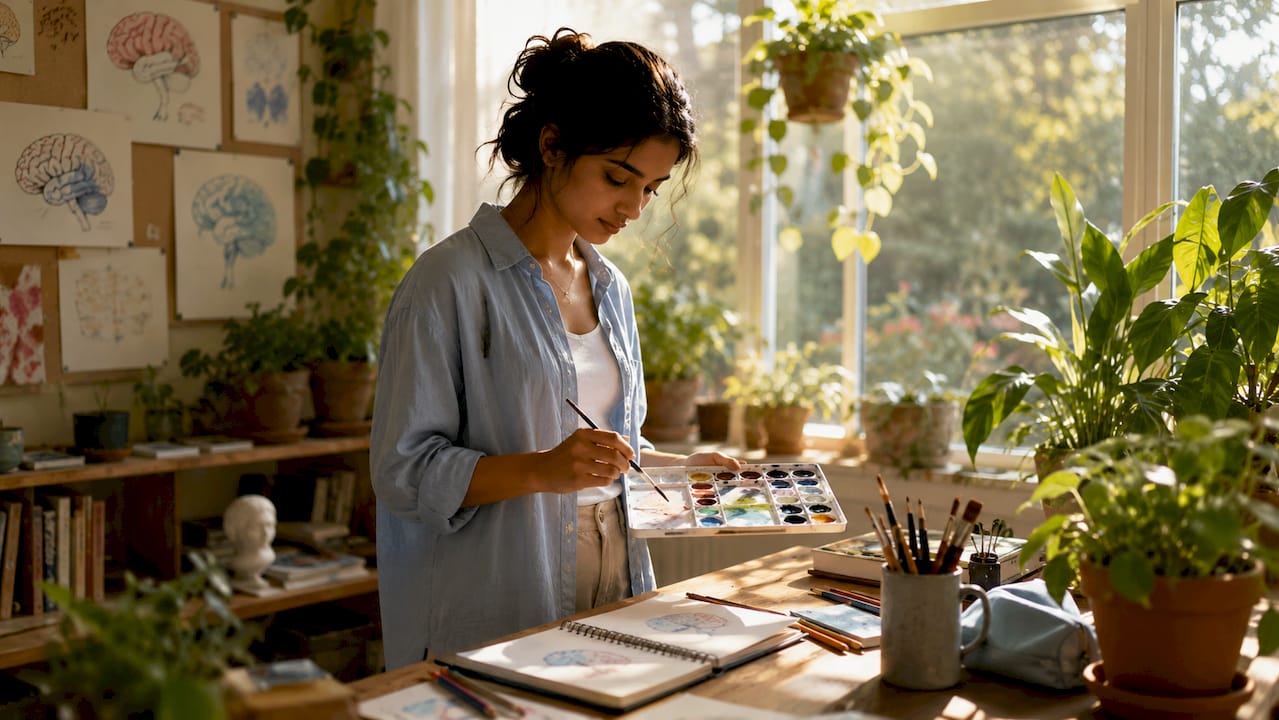
Active creation vs. passive viewing: what the research shows
Many people assume you need to make art to get the benefits. The research says otherwise.
| Engagement Type | Example Activities | Key Mental Health Effect |
|---|---|---|
| Active creation | Painting, drawing, writing, music | Dopamine release, cortisol reduction, skill-building |
| Passive viewing | Museum visits, biophilic art installations | Emotion regulation, anxiety reduction, neural activation |
| Group participation | Art therapy sessions, community murals | Social bonding, identity reinforcement, loneliness reduction |
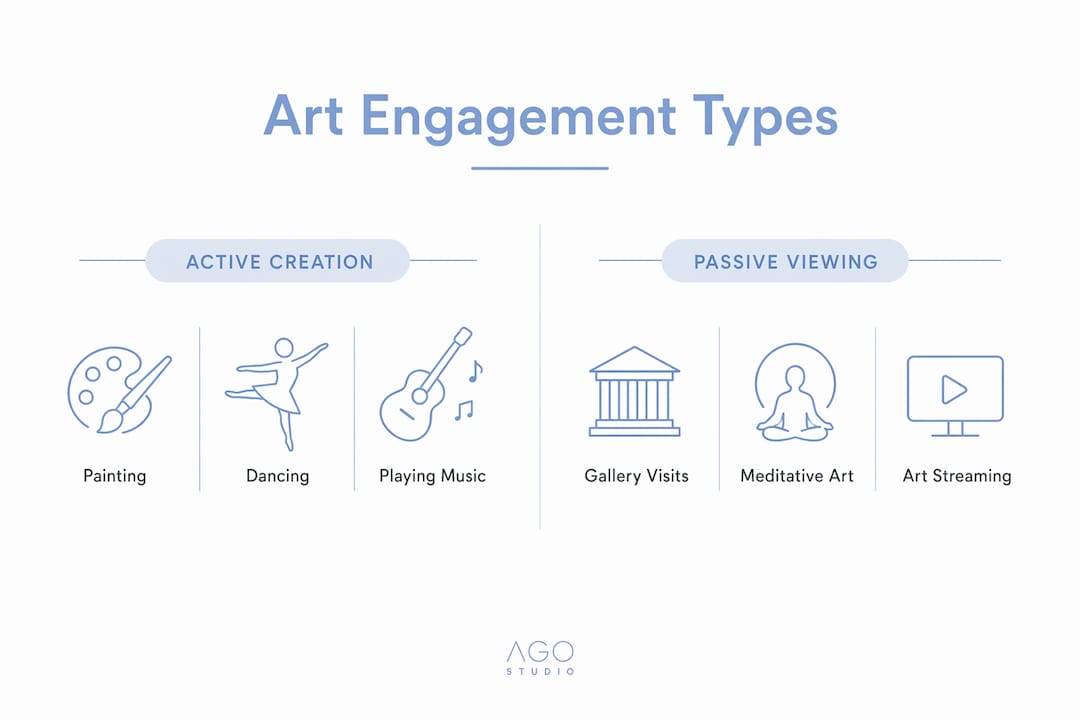
Passive engagement with art activates the same emotion regulation neural circuits as active art-making. This finding broadens who can benefit. You do not need to be creative or skilled. You need only to engage.
Pro Tip: Focus on the process, not the product. Research from Psychology Today confirms that perfectionism undermines mental health gains from art. Scribble, experiment, and let go of the outcome.
Does art therapy actually reduce depression and anxiety?
Art therapy is the clinical application of art-based interventions, guided by a trained therapist, to address psychological symptoms. It is distinct from casual creative hobbies, though both offer benefits.
The clinical evidence is strong. A meta-analysis of 41 randomized controlled trials involving 3,791 participants found that group art interventions significantly reduce depression symptoms in older adults. Passive interventions produced a standardized mean difference of -1.97, compared to -0.67 for active interventions. A difference this large is clinically meaningful. It suggests that simply being surrounded by art in a structured setting can outperform active art-making for certain populations.
A separate 12-month longitudinal study of 300 urban residents found that consistent access to biophilic art installations reduced depression symptoms by 67% and anxiety symptoms by 72%. These were measured using the standardized PHQ-9 and GAD-7 scales, the same tools used in clinical psychiatric settings. That level of symptom reduction rivals many pharmaceutical interventions.
Art therapy formats that deliver results
Art-based interventions span a wide range of formats, each with documented benefits:
- Visual art therapy: Painting, drawing, and collage help externalize internal emotional states that are difficult to verbalize, making them especially effective for trauma survivors.
- Music therapy: Rhythm and melody engage the limbic system directly, reducing anxiety and improving mood in both clinical and community settings.
- Drama therapy: Role-play and storytelling build emotional distance from painful experiences, supporting identity reconstruction after loss or trauma.
- Creative writing: Expressive writing, including journaling and poetry, reduces intrusive thoughts and improves cognitive processing of difficult events.
Arts-based social prescribing offers a non-stigmatizing, side-effect-free alternative to purely symptom-focused treatment. This matters because stigma remains one of the biggest barriers to mental health care. Art therapy does not feel like a clinical intervention to most participants. That accessibility is part of its power.
How can you use art for mental wellness every day?
You do not need a therapist, a studio, or a talent for art to benefit from creative engagement. The key is consistency over intensity.
Research summarized by New Scientist shows that regular day-to-day engagement with art, what researchers call the “arts exposome,” is more effective for long-term brain and mental health than occasional creative sessions. Think of it like exercise. A 20-minute daily walk beats a single two-hour gym session once a month. The same logic applies to art.
Here are practical ways to build art into your routine without overhauling your schedule:
- Spend 10 minutes sketching or doodling during your morning coffee instead of scrolling your phone.
- Attend a local art studio event once a month to combine passive viewing with social connection.
- Place one meaningful print in your workspace where you will see it daily. Passive exposure counts.
- Listen to a music playlist intentionally for 15 minutes, focusing on how the sound affects your mood rather than using it as background noise.
- Try a creative writing prompt for five minutes before bed to process the day’s emotions.
Pro Tip: The biggest misconception about art and mental health is that you need to be “artistic.” You do not. The brain responds to creative engagement regardless of the quality of the output. Start ugly. Start small. Start today.
One common objection is that art feels self-indulgent or unproductive. Reframe it as preventive health care. The arts’ mental health benefits are multidimensional, covering emotional, cognitive, social, and physiological improvements that most single therapeutic approaches cannot match.
Does art build social connection and emotional support?
Art does not only work on the individual. It builds the social fabric that protects mental health at a community level.
Shared creative experiences create a specific kind of social bond. When people make or experience art together, they share vulnerability, interpretation, and meaning. That shared experience reduces loneliness more effectively than many structured social activities. Art creates conversation and community bonds that support long-term mental wellness in ways that solo activities cannot replicate.
Group art therapy amplifies individual benefits through three specific mechanisms:
- Shared vulnerability: Participants witness each other’s creative process, normalizing emotional expression and reducing shame around mental health struggles.
- Identity reinforcement: Collective artistic projects give individuals a sense of contribution and belonging, which directly supports self-esteem and purpose.
- Reduced isolation: Regular group sessions create predictable social contact, which research consistently links to lower rates of depression and anxiety.
Arts-based interventions provide non-stigmatizing methods to address whole-person health, making them especially valuable in public health strategies targeting loneliness and social disconnection. Community murals, open studio nights, and art-based social prescribing programs all operate on this principle. The art is the vehicle. The connection is the medicine.
Key takeaways
Art supports mental health through measurable biological, psychological, and social mechanisms that are accessible to everyone, regardless of artistic skill.
| Point | Details |
|---|---|
| Brain-level impact | Art modulates the Default Mode Network and releases dopamine, directly reducing stress and negative thought loops. |
| Passive exposure works | Viewing art activates the same emotion regulation circuits as making it, so displaying meaningful art at home counts. |
| Clinical evidence is strong | A meta-analysis of 41 trials found art interventions significantly reduce depression, with passive formats showing the largest effect. |
| Consistency beats intensity | Daily small engagements with art build cumulative brain and emotional health benefits more effectively than occasional sessions. |
| Social art multiplies benefits | Group creative experiences reduce loneliness, reinforce identity, and build community bonds that protect long-term mental health. |
Art is not a luxury. it is a health practice.
I have spent years watching people dismiss art as decoration or hobby, something nice to have when life is going well. That framing is backwards. Art is most valuable precisely when life is hard.
What strikes me most about the current research is not the statistics. It is the implication. The DMN reconfiguration finding means that art literally changes how your brain talks to itself. That is not a metaphor. That is neuroscience. And yet most people treat a 10-minute sketching session as less legitimate than a 10-minute meditation. They are doing the same thing to the same brain systems.
The other thing I have learned is that perfectionism is the single biggest barrier between people and art’s mental health benefits. The moment someone says “I am not artistic,” they have already blocked the neurochemical process that would help them. The brain does not grade your drawing. It rewards the act of making.
My honest advice: treat art the way you treat brushing your teeth. Not a grand creative event. A daily habit with cumulative effects. Hang something on your wall that moves you. Doodle on a notepad during a stressful call. Spend three minutes with a piece of music you love. None of this requires talent. All of it requires only attention.
The research is clear. The access is easier than ever. The only thing standing between you and these benefits is the belief that art is for someone else.
— DAVID
Bring art into your space with Agostudio
Knowing why art supports mental health is the first step. Putting it on your wall is the second.
Agostudio curates original artworks selected specifically to evoke warmth, connection, and emotional resonance. Every piece is chosen because it moves people, not just decorates a room. Browse the full collection of art prints to find work that fits your space and speaks to you personally. For regular, consistent exposure to new original art, the Artist Print Club delivers curated prints from real artists on a subscription basis. It is the simplest way to build your arts exposome without thinking about it.
FAQ
What exactly is art therapy?
Art therapy is a clinical mental health practice where a trained therapist uses art-making and creative expression to help clients process emotions, reduce symptoms, and improve psychological wellbeing. It is distinct from casual art hobbies but both offer documented mental health benefits.
Do you need artistic skill to benefit from art?
No artistic skill is required. Research confirms that the brain’s reward and stress-reduction responses to creative engagement are triggered by the act of making or viewing art, not by the quality of the output. Perfectionism actually reduces the mental health gains.
How quickly does art reduce stress?
Physiological changes including cortisol reduction and lower heart rate can occur during a single creative session. Long-term benefits like reduced depression and anxiety symptoms build over weeks and months of consistent engagement with art.
Is passive art viewing as effective as making art?
For emotional regulation and anxiety reduction, passive engagement with art activates similar neural circuits as active creation. A 12-month study found biophilic art installations reduced depression by 67% and anxiety by 72% through passive exposure alone.
How often should you engage with art for mental health benefits?
Daily engagement, even in small doses, produces stronger cumulative benefits than occasional sessions. Researchers describe this pattern as the “arts exposome,” a consistent diet of creative exposure that builds brain plasticity and emotional resilience over time.